
What Is an Education Email List?
A B2B Buyer’s Guide | K12 Lists
Education companies rarely struggle to find schools. The challenge is finding the right contact inside the right school. Your campaign targeting school administrators is sitting at a 4% open rate. Your SDR says half the contacts bounced. Your subject line test never got a fair chance because the list underneath it was already broken before you pressed send.
The problem is rarely the message. It is the data beneath it. This guide covers what an education email list actually is, what separates a quality education contact database from a generic business list with a school filter applied, how to evaluate a provider before you commit, and how to use education contact data in a way that builds pipeline rather than unsubscribe rates.
- 01 What Is an Education Email List?
- 02 What a Quality Education Contact Record Contains
- 03 Education Email List vs. Generic B2B Database
- 04 Who Should Be on Your Education Marketing List
- 05 Five Questions to Ask Before You Buy
- 06 Using Education Contact Data Responsibly
- 07 Why Targeted Education Data Improves ROI
- 08 Frequently Asked Questions
What Is an Education Email List?
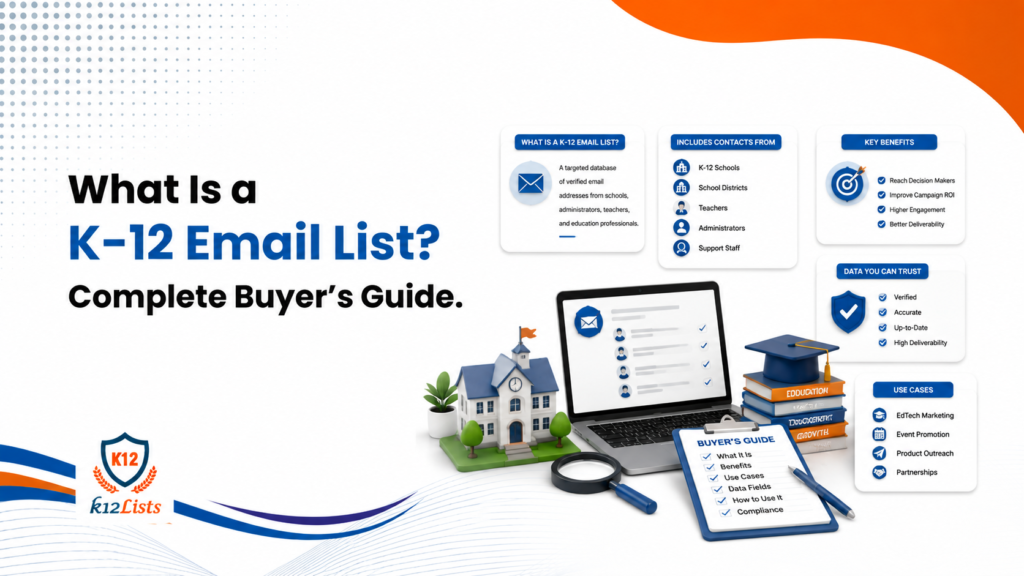
An education email list is a verified collection of professional contact records for individuals employed at K-12 schools, school districts, charter schools, colleges, and universities. Each record contains role-specific contact data, institutional attributes, and geographic identifiers that allow B2B marketers to identify and reach education-sector decision-makers by function, institution type, and region.
A K-12 education database is more than a school directory. It organizes contacts by institution type, professional role, geographic location, and school classification. The K-12 sector spans roughly 130,000 schools across the United States, each with multiple stakeholders involved in different purchasing decisions. The distinction between a generic directory and structured contact intelligence is what separates campaigns that reach decision-makers from outreach that disappears into a general inbox.
Unlike a general business contact list, a purpose-built education email database is organized around the internal structure of the education sector itself: district hierarchies, school types, grade levels, enrollment sizes, and functional departments such as curriculum, technology, administration, and procurement.
Verified Education Contacts
Multi-step verified professional emails with current role attribution across public, private, and charter institutions.
Role-Based Segmentation
Filter by grade level, institution type, district size, geographic region, and professional function simultaneously.
Decision-Maker Targeting
Reach principals, curriculum directors, technology coordinators, and procurement managers by specific role and purchasing authority.
CRM-Ready Data Fields
Structured contact fields that map cleanly to major CRM platforms with no manual reformatting required.
What a Quality Education Contact Record Contains
A quality education contact record includes the contact’s name, professional email, direct phone, job title, department, seniority level, school or district name, institution type, education level, enrollment size, and geographic data. The value is not in the email address alone. It is in the contextual attributes that make role-based filtering and audience segmentation possible.
When you request a sample from an education data provider, knowing what to look for inside each record matters as much as knowing the total number of contacts in the file. Here is how the field categories break down, and why each one changes how you use the data:
| Data Category | Fields Included |
|---|---|
| Contact Details | Full name, professional email address, direct phone number, job title, seniority level |
| Professional Role | Department (curriculum, IT, administration, procurement, finance), functional responsibility, purchasing authority |
| Institutional Data | School or institution name, district name and identifier, enrollment size, staff count |
| School Classification | Public, private, charter, magnet, vocational, community college, four-year university |
| Education Level | Elementary, middle school, high school, K-12 district administration, higher education |
| Geographic Data | State, region, city, county, ZIP code, urban/suburban/rural classification |
Each of these fields is a segmentation variable, not just a data point. The enrollment size field tells you whether you are targeting a small rural school or a large urban district with a structured purchasing committee. The school type field signals whether you are pitching to a budget cycle tied to public funding or to a private school business director with independent authority. That context changes your message, timing, and channel before you write a single word of copy.
Want to see what this data looks like for your specific audience? Request a free sample from K12 Lists before you build your next campaign.
Request a Free SampleEducation Email List vs. Generic B2B Database: What’s the Real Difference?
Generic B2B databases are built around commercial company structures and often undercount, misclassify, or omit education institutions entirely. A purpose-built education email database applies education-specific sourcing and verification logic that covers roles and school types commercial databases were never built to track. The result is more complete contact coverage and meaningfully better accuracy for education-sector campaigns.
If you have used a general-purpose business contact platform and applied “education” as an industry filter, you have already encountered the gap. Here is where it shows up most clearly:
Coverage gaps. General B2B databases are organized around commercial company size, revenue, and standard industry classification codes. The education sector does not map cleanly onto those structures. A school district with 80,000 students and a $500 million operating budget may appear as a small organization in a commercial database because its financial footprint does not resemble a mid-market private company. Those contacts simply do not appear where they should.
Role gaps. The decision-making roles that matter most in K-12 and higher education, such as Superintendents, Curriculum Directors, Principals, School Board Members, and Department Heads, are frequently absent from or mislabeled in general contact databases. These titles do not exist in the commercial world, so they tend to get filed under generic administrative categories that make them impossible to filter by function or purchasing responsibility.
Verification gaps. Staff movement in education follows the academic calendar, not fiscal quarters. Teachers change schools at the end of every school year. Principals move into district roles. Districts reorganize after budget approvals. A general-purpose database refreshed on a commercial schedule carries significant contact drift across education records without any sector-specific validation applied to catch it.
Education buying cycles are longer and more committee-driven than most B2B verticals. Organizations that reach the right contacts early, before the formal evaluation begins, hold a structural advantage that volume-based outreach on stale data cannot replicate. The quality of your contact list is a competitive lever, not just a campaign input.
Who Should Be on Your Education Marketing List
The right contacts depend entirely on what you sell and who controls the buying decision for your solution category. Education purchasing is not centralized in a single role or department. Budget authority, approval chains, and the relevant decision-maker all shift based on whether you are selling technology, curriculum materials, professional development, operational supplies, or staffing solutions.
Here is how the relevant audience maps to product category:
- EdTech companies and SaaS platforms reach IT Directors, Technology Coordinators, and Chief Technology Officers at the district level. For classroom-level tools with a bottom-up adoption motion, Teachers are a viable entry point before escalating to district buyers.
- Curriculum and instructional materials publishers target Curriculum Directors, Department Heads, and Instructional Coordinators at the school or district level, with Principals as secondary adoption champions.
- Professional development and training providers engage Superintendents, Assistant Superintendents, and HR Directors at the district level, who hold both authority and budget for this category.
- School suppliers and equipment vendors access Procurement Directors, Business Administrators, and Facilities Managers, particularly at the district level where centralized purchasing decisions are made.
- Staffing and recruitment solutions engage HR Directors, Principals, and District Administrators, with the appropriate focus depending on whether you are filling classroom positions or administrative roles.
- Nonprofits, grant organizations, and program partners identify Program Directors and Superintendents for partnership and funding outreach at the district and state levels.
A school email list is not a monolithic audience. The contacts that matter for your campaign depend on your product’s functional category. A quality education data provider lets you filter by role, institution type, district size, and education level simultaneously, rather than requiring you to work with whatever is in a pre-packaged file.
Five Questions to Ask Before You Buy Education Contact Data
Evaluate education data providers on verification methodology, update frequency, segmentation depth, coverage breadth, and sample availability. These five questions separate products built for real education marketing from bulk files with a targeting label applied after the fact. Most buyers skip this step. Most providers are hoping they will.
-
1How are contacts verified, and when was this segment last refreshed?
Verification methodology matters more than a provider’s stated accuracy figure. Ask specifically: how are email addresses validated, what sources are used for institutional records, and when was this particular segment most recently updated? Education staff movement is concentrated at the beginning and end of each academic year. A database refreshed once annually may carry meaningful drift by late spring if the refresh happened the previous summer.
-
2Can I segment by role and institution type at the same time?
A provider who can only filter by state and job title is limiting your targeting precision before your campaign begins. You should be able to combine functional role, school type, enrollment range, education level, district size, and geography in a single segment request, not as sequential filters that narrow from a poor starting pool.
-
3What does each contact record include beyond email?
An email address alone is a single-channel record. A quality education mailing list includes phone number, job title, institutional affiliation, district, geographic data, and role attributes that support multi-channel outreach and accurate CRM enrichment. If a provider offers only email and name, you are likely looking at a bulk file rather than a structured contact database.
-
4Can I get a sample before I commit to purchasing?
A credible education data provider will offer a sample for your specific target segment before you sign anything. If a provider declines this request, treat it as a meaningful signal about their confidence in what the data actually looks like for your audience, rather than in aggregate numbers on a marketing page.
-
5How does the provider approach data sourcing and compliance alignment?
Ask whether the data is sourced from professional, institutional, or publicly available records, and whether the provider can clearly describe their approach to data responsibility. Transparency here protects your sender reputation, your deliverability, and your relationship with a sector that is particularly sensitive to irrelevant or low-quality vendor outreach.
Not sure if your target segment is in the database?
K12 Lists can generate a custom contact count for your specific audience before you commit. Tell us your role, region, institution type, and campaign goals and we will show you exactly what is available.
Get a Custom Contact CountUsing Education Contact Data Responsibly
Schools are not just another commercial vertical. Educators receive a high volume of vendor outreach, and B2B organizations that build lasting pipeline relationships with the education sector approach it with more care than a standard demand-generation campaign. Responsible use of education contact data starts with how you segment, how you personalize, and how you time your outreach relative to the academic calendar.
Here is what responsible practice looks like across the campaigns that tend to perform well in this sector:
- Personalize to role, not just to name. A Curriculum Coordinator and a District Technology Director have entirely different professional concerns, even if they work at the same district. Generic “school administrator” messaging that does not speak to the recipient’s functional responsibility gets ignored at best and flagged at worst.
- Time campaigns to the academic calendar. The primary purchasing window for the following school year runs roughly from January through April in K-12. Budget planning conversations happen in this window. Outreach that lands during summer transition periods often misses the people you are trying to reach entirely.
- Use the data for targeted outreach, not volume plays. A well-sourced education contact list is a precision instrument. Treating it as a bulk distribution channel undermines your deliverability, damages your sender reputation, and erodes trust with an audience that is particularly attuned to irrelevant vendor communications.
- Honor opt-out requests immediately. Beyond the legal baseline, prompt opt-out handling signals professional standards to educators. In a sector where word travels quickly among professional communities, that signal carries more weight than it does in many other verticals.
Why Targeted Education Data Improves ROI Across Every Campaign Channel
The primary driver of B2B email campaign performance in the K-12 sector is not subject line optimization, send time, or template design. It is audience quality. In an environment where procurement is committee-driven and relationship-dependent, reaching the wrong person costs more than it appears. It does not just fail. It often creates a negative impression that closes the door on future outreach to that institution.
Segmentation is the mechanism that converts contact data into campaign performance. By filtering K-12 contacts according to institution type, role seniority, grade level focus, geographic region, and district size, organizations ensure that each outreach message reaches a stakeholder who has both the authority and the context to act on it. A Curriculum Director at a Title I district has different budget cycles and priorities than a Department Head at a private independent school, and those differences should be reflected in every campaign.
The ROI case for verified, role-segmented K-12 data comes down to cost efficiency. Campaigns built on clean contact data spend less time managing bounces, list cleanup, and compliance issues. They generate higher engagement rates because the message-to-audience fit is tighter. And they convert at meaningfully higher rates because the contacts reached actually hold decision-making authority in the relevant category.
For organizations building sustained education marketing programs rather than one-time outreach campaigns, verified K-12 contact data functions as infrastructure. The quality of that infrastructure determines the ceiling of what any campaign can achieve, regardless of how well every other element is executed. Contact our team today to discuss your audience requirements.
Frequently Asked Questions
What is an education email list?
An education email list is a verified collection of professional contact records for individuals employed at K-12 schools, school districts, colleges, and universities. Records typically include name, professional email, job title, institutional affiliation, and geographic data, enabling B2B marketers to reach specific education-sector decision-makers rather than broad institutional audiences.
How is an education email list different from a generic B2B database?
Generic B2B databases are built around commercial company structures and often misclassify or underrepresent the education sector. Roles such as Superintendents, Principals, and Curriculum Directors are frequently absent or mislabeled. A purpose-built education email database applies education-specific sourcing and verification logic, improving both contact coverage and accuracy for education-sector campaigns.
Who are the key decision-makers in K-12 school purchasing?
Decision-makers vary by product category. Technology purchases typically involve District IT Directors and Chief Technology Officers. Curriculum products are driven by Curriculum Directors and Principals. Administrative and operational solutions often go through Superintendents and Procurement Managers. Budget authority in K-12 typically sits at the district level rather than the individual school building.
How often should education contact data be updated?
Education staff turnover is closely tied to the academic calendar, with significant movement at the start and end of each school year. Quality providers refresh education contacts at least annually, with many updating more frequently. Look for a provider who discloses their refresh cadence and explains how they validate contacts specifically within the education sector.
Can I target specific school types or districts?
Yes. A purpose-built education contact database allows filtering by school type, such as public, private, charter, and magnet schools, as well as by education level, district name, state, city, ZIP code, enrollment range, and staff size. These filters let you build an audience that matches your actual campaign requirements rather than the closest available approximation in a pre-packaged file.
Is using an education email list for B2B outreach permitted?
Using professionally sourced contact data to reach education-sector professionals for relevant B2B outreach is generally permissible when contacts come from professional or institutional sources and are used for role-relevant communications. Best practices include honoring opt-out requests promptly and working with a transparent provider. Consult your legal team for jurisdiction-specific guidance on your campaigns.
What types of B2B organizations commonly use education email lists?
Regular users include EdTech and SaaS companies targeting schools and districts, curriculum and assessment publishers, professional development providers, school technology vendors, supply and equipment companies, event organizers targeting educators, and staffing firms focused on the education sector. Any B2B organization whose products serve schools, districts, colleges, or universities is a potential user.
What should I ask an education data provider before purchasing?
Ask how contacts are verified and when they were last updated, whether you can segment by role and institution type, what fields each record includes beyond email, whether a sample is available before purchase, and how the provider approaches data sourcing and compliance alignment. A credible provider answers all five questions clearly and without hesitation.
Ready to Connect With Education Decision-Makers?
Accurate, role-specific education contact data is the foundation of every effective school outreach strategy. Tell us about your audience requirements and we will build the right segment for your campaign.