
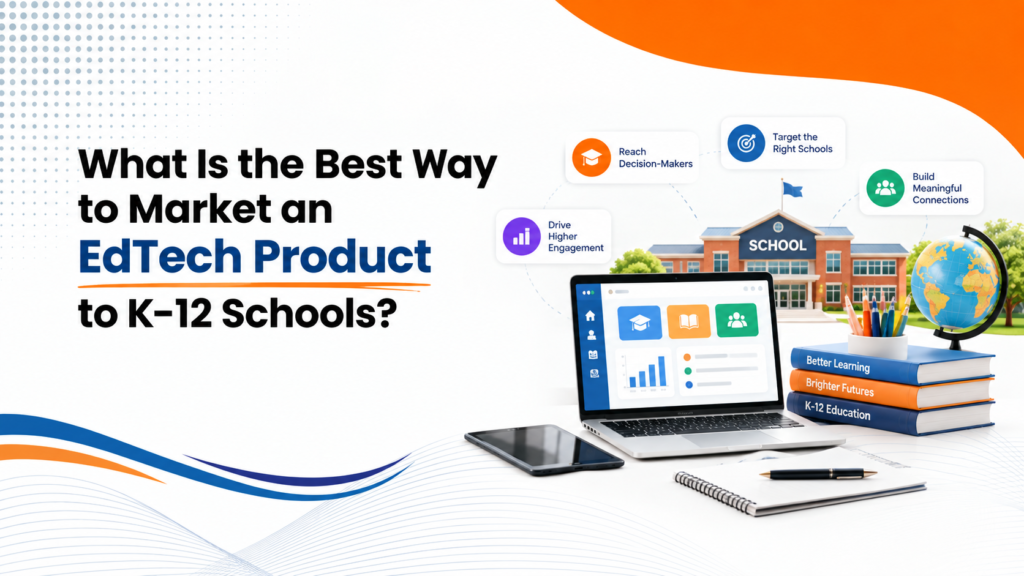
The buying cycle is longer, decision-making authority is distributed across multiple roles, and the window for reaching the right person is far narrower than most EdTech founders realize. Here is the complete framework.
Marketing an EdTech product to K-12 schools is not like running a standard B2B campaign. The buying cycle is longer, the decision-making authority is distributed across multiple roles, and the window for reaching the right person at the right time is far narrower than most EdTech founders realize.
The most effective strategy combines classroom-first messaging with precise multi-stakeholder targeting across the full decision-making chain inside a school district. If your outreach treats the school as a single buyer, you will lose pipeline to vendors who understand how procurement actually works at the district level.
- Why K-12 procurement is structurally different from corporate B2B
- The most common failure points in EdTech outreach
- A three-step framework that consistently generates pipeline
- How AI is reshaping district-level discovery
- Answers to the most-searched questions on education marketing
Request a sample list segmented by role, district, and state before your next campaign launch.
How Did K-12 EdTech Procurement Get So Complex?
School purchasing has changed more in the last fifteen years than in the previous fifty combined. What once happened through printed catalogs, regional trade shows, and face-to-face district meetings now runs through centralized digital procurement portals, multi-vendor RFPs, and formal committee evaluations that routinely involve three to twelve stakeholders before a purchase order is signed.
That shift matters for your marketing because the old playbook, sending a brochure to a single principal and waiting for a callback, no longer produces results.
Modern school leaders are buried in vendor proposals. They move quickly during budget planning season and slow to a near halt once the school year is underway. If your outreach does not reach the right person with a message that speaks directly to their responsibility, your campaign disappears into an email folder that never gets opened.
Today’s school buyers also operate under significant institutional scrutiny when approving new vendor relationships. Demonstrating pedagogical alignment, confirming integration compatibility with existing systems, and surfacing evidence of measurable learning outcomes are baseline expectations. Your marketing content needs to answer those questions before a buyer ever requests a demo.
Why Does Traditional B2B Marketing Fall Apart in the K-12 Sector?
Most EdTech founders run their first school outreach campaign using the same approach they would apply to a mid-market SaaS buyer. The campaign underperforms, and the team blames the creative. The real problem is structural. Traditional B2B marketing fails in K-12 because schools do not operate like corporate accounts. Purchasing authority is distributed, budgets are locked to strict fiscal calendars, and contact records across school districts are far more fragmented than a standard CRM entry.
Here is where most EdTech campaigns specifically break down:
Teachers use the product daily. Principals sponsor the pilot. Curriculum coordinators evaluate instructional alignment. Technology directors approve system integrations. Superintendents sign the final budget line. Messaging designed for one of these stakeholders will be ignored or forwarded by all the others, and not always to the right person next.
Most districts finalize procurement decisions between March and June during active budget planning. Launching a campaign in October is almost always too early to create urgency. Launching in September is almost always too late to make the budget cycle. Getting the timing wrong wastes spend on contacts who are not in a position to act regardless of how interested they are in your product.
Outdated job titles, bounced email addresses, and contacts who transferred out of the district months ago do not just reduce deliverability. They trigger spam filters, damage your sender reputation, and close district relationships before they ever open. A campaign built on bad data is expensive and invisible at the same time.
What Does an Effective K-12 Marketing Strategy Actually Look Like?
The framework that consistently generates pipeline in K-12 education sales has three steps. Each one depends on the one before it, and skipping any step means executing the next one on faulty assumptions. An effective K-12 marketing strategy leads with classroom utility, maps every stakeholder with a tailored messaging track, and executes on verified contact data so outreach reaches the people who hold actual purchasing influence.
Lead with classroom utility, not software features
School buyers do not care about your feature list. They care about what happens in Room 204 on a Tuesday morning. Your messaging should answer one question before anything else: does this product save teachers meaningful time or improve measurable learning outcomes? If your first sentence cannot answer that clearly, rewrite it before you launch anything.
Abstract capability claims, platform scalability language, and UI descriptions do not land in education environments. Concrete workflow improvements and outcome evidence do.
Build messaging tracks for each stakeholder in the buying chain
Map your outreach by role, not by district. The districts that purchase are the ones who felt understood at every level of the decision. One message cannot serve all five personas without being ignored by most of them.
Execute outreach on verified, segmented contact data
The quality of your contact records determines whether your campaign reaches real decision-makers or evaporates into bounce queues. Verified education contacts, segmented by role and district, are not a competitive advantage in K-12 marketing. They are the operating baseline for any campaign that produces real results.
Explore verified education contact segments by role, region, and district size today.
How Is AI Changing the Way Districts Discover EdTech Products?
AI-assisted discovery is already reshaping how school administrators find and evaluate EdTech vendors, in many cases before a sales representative ever makes contact. Districts are increasingly using AI tools to surface vendor options, pre-screen products against district criteria, and build short-lists before engaging any vendor directly. LLM-generated recommendations and automated review aggregators are becoming early-stage filters in the school purchasing process.
What this means for your marketing strategy right now:
Clear definitions, direct answers to buyer questions, and well-organized frameworks make your content far more likely to surface in AI-generated overviews and LLM recommendation outputs. If the answer to a buyer’s question is buried five paragraphs into a promotional section, it will not be extracted.
As school staff mobility increases and administrative restructuring accelerates across districts nationwide, contact records that were accurate six months ago may already be connected to staff who have transferred or retired. Campaigns built on stale contact data produce compounding deliverability failures that are difficult to diagnose and expensive to rebuild.
If your value proposition is wrapped in promotional language or organized poorly for reading systems, it will not surface in AI-generated recommendations regardless of how strong your product actually is. The EdTech brands building on accurate data, structured content, and multi-stakeholder targeting now will hold a measurable structural advantage as AI-assisted procurement scales across more districts.
Frequently Asked Questions
Direct answers to the questions EdTech teams ask most about K-12 marketing, outreach timing, and contact data quality.
Power Your K-12 Outreach with Verified Decision-Maker Data
Reaching the right K-12 stakeholders is not a targeting problem. It is a data quality problem that looks like one.
The EdTech teams that consistently generate pipeline in the education sector are not running harder campaigns. They are running better-targeted ones, built on verified contact records that cover the full decision-making chain by role, district, and geography.
When your outreach is built on accurate, role-segmented education contacts, every element of your campaign performs better. Deliverability improves. Personalization at scale becomes operationally feasible. And your pipeline reflects actual buyer intent rather than random engagement from a poorly segmented list.
If your contact list has not been refreshed in the last six months, your first investment should be in the data layer, not the creative layer.
Access verified, regularly updated contact records covering superintendents, principals, curriculum coordinators, technology directors, and administrators across school districts nationwide. Every contact is segmented by role, district size, and state so your outreach connects with the people who hold purchasing authority.