
What Is a K-12 Email List?
Education companies rarely struggle to find schools. The challenge is finding the right contact inside the right school. This guide covers what a K-12 email list includes, who uses it, and how to evaluate quality before you buy.
What Is a K-12 Email List?
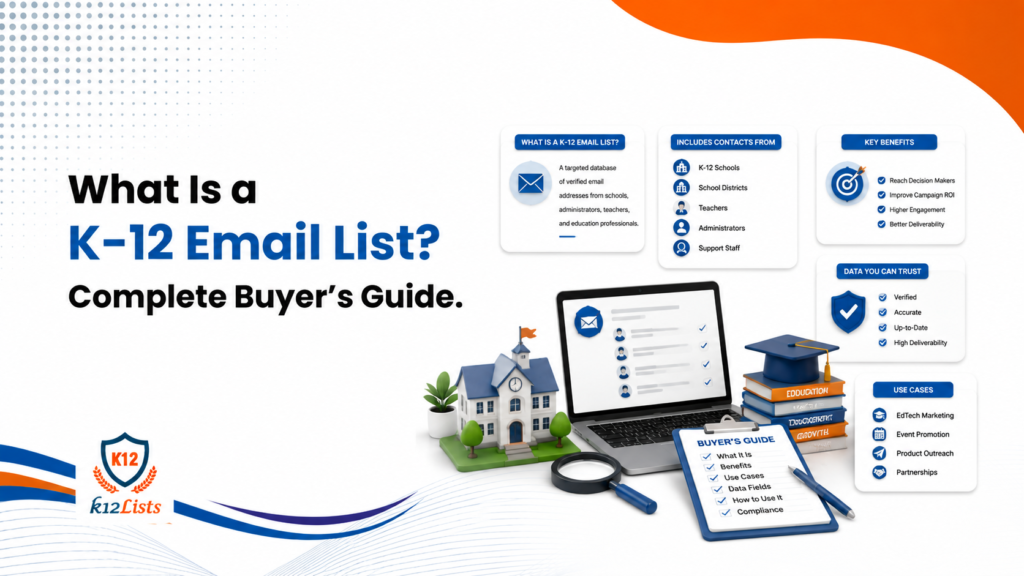
A K-12 education database is more than a school directory. It organizes contacts by institution type, professional role, geographic location, and school classification. The K-12 sector spans roughly 130,000 schools in the United States, each with multiple stakeholders involved in different purchasing decisions.
Understanding that distinction — directory vs. structured contact intelligence — is what separates campaigns that actually reach decision-makers from outreach that disappears into a generic inbox.
Verified Education Contacts
Multi-step verified professional emails with current role attribution across public, private, and charter institutions.
Segmented School Data
Filter by grade level, institution type, district size, geographic region, and professional role simultaneously.
Decision-Maker Information
Reach principals, curriculum directors, technology coordinators, and purchasing managers by specific purchasing role.
CRM-Ready Format
Structured data fields map cleanly to Salesforce, HubSpot, and major CRM platforms with no manual reformatting.
Why Do Businesses Use K-12 Email Lists?
A K-12 email database helps organizations identify decision-makers by role, reach new geographic markets efficiently, and build segmented campaigns that reflect how education buying actually works.
The difference between a school directory and a structured contact database is the same as the difference between a map and a navigation system. The map shows you where things are. The navigation system tells you the best route based on where you’re going and who you need to reach when you get there.
Who Uses K-12 Email Lists?
The use cases vary by stakeholder, but the structural benefit is consistent: role-level contact data lets each organization’s outreach match the specific decision-making layer it’s trying to reach.
- EdTech companies reach technology coordinators and curriculum directors for software and digital learning solutions.
- Publishers connect with department heads and literacy coaches for curriculum materials and adoption decisions.
- School suppliers access purchasing managers and facilities directors for equipment, furniture, and services procurement.
- Training and PD providers identify district-level HR contacts and principals for professional development programs.
- Nonprofits and grants teams reach program directors and superintendents for partnership and funding outreach.
Need to reach K-12 decision-makers without months of manual prospecting?
Structured, verified education contact data gives your team a head start. Request a sample to see the quality before committing.
What Does a K-12 Email Database Include?
| Data Category | Examples |
|---|---|
| Institution Details | School name, district affiliation, grade levels served, enrollment size |
| Contact Information | Professional email address, direct phone number, department |
| Professional Details | Job title, seniority level, purchasing authority |
| School Classification | Public, private, charter, magnet, religious affiliation |
| Geographic Data | City, state, region, ZIP code, urban/suburban/rural classification |
Well-structured K-12 databases also include district affiliation and grade level coverage, enabling more granular audience segmentation across campaigns than institution name and email alone can provide.
Why Does Data Quality Matter When Choosing a K-12 Database?
Verified K-12 email lists should reflect multi-step contact verification, academic-calendar-aligned update cycles, and accurate role attribution. When evaluating a provider, always request a sample. Its completeness is a reliable predictor of full-list quality.
What to look for in verified education data
- Multi-step verification: Email syntax validation, domain verification, and SMTP confirmation at minimum.
- Academic calendar alignment: Update cycles should account for summer transitions when staff changes are highest.
- Role attribution accuracy: Job title data should reflect current purchasing authority, not prior-year records.
- Bounce rate transparency: Reputable providers share expected bounce rates before purchase, not after delivery.
How Do K-12 Email Lists Improve Education Marketing Campaigns?
Role-specific segmentation gives organizations the ability to write messages that address what each stakeholder actually cares about, rather than sending one broadcast to everyone in the building.
- Audience selection: Define the institution types, grade levels, and geographic regions your product or service serves.
- Role segmentation: Layer in the specific job functions that have purchasing authority for your category.
- Message personalization: Write value propositions that address each role’s specific objectives and concerns.
- Campaign execution: Deploy across email, direct mail, or digital channels with clean, formatted contact records.
- Engagement tracking: Monitor open rates and reply rates by segment to identify highest-intent audiences for follow-up.
Your outreach is only as good as the contacts behind it.
Explore structured K-12 contact data with role-level segmentation across public, private, and charter institutions.
How Do You Choose the Right K-12 Email List Provider?
Ask these five questions before committing to a K-12 email list provider:
- Verification: How is contact information confirmed, and when was it last updated? What is the expected bounce rate?
- Segmentation: Can you filter by role, institution type, grade level, and state simultaneously? What field combinations are available?
- Coverage: Does the list include the specific institution types — public, private, charter, magnet — your campaign targets?
- Update frequency: Does the refresh cycle align with the academic calendar? Summer transitions are when most staff changes occur.
- Sample: Will the provider share a representative sample before purchase? Refusal to provide a sample is itself a data quality signal.
What Are the Common Mistakes Businesses Make When Buying K-12 Data?
The channel is almost never the problem when education campaigns underperform. The contact quality is.
- Buying for volume: 50,000 unverified records will consistently underperform 5,000 verified, role-segmented contacts for most education campaigns.
- Skipping segmentation: A single message sent to teachers, principals, and district administrators simultaneously will resonate with none of them.
- One-time purchase mentality: Education staff turn over significantly each academic year. A database that isn’t refreshed becomes less valuable with every passing semester.
- Ignoring institution type: A charter school has different procurement processes than a public district, and a private school operates differently from both.
What Is the Future of Education Marketing With Data-Driven Outreach?
Organizations that reach the right contacts early in a longer, committee-driven procurement process hold a structural advantage that volume-based outreach cannot replicate. The competitive gap between organizations with structured audience intelligence and those without it is widening, not closing.
Data-driven outreach in K-12 marketing isn’t a tactic anymore — it’s the baseline expectation for organizations that want repeatable results in a sector where relationships, timing, and relevance determine which vendors get considered and which ones don’t. Get in touch with our team today to discuss your audience requirements.
Why Targeted Education Data Improves ROI Across Every Campaign Channel
The primary driver of B2B email campaign performance isn’t subject line optimization, send time, or template design. It’s audience quality. In the K-12 sector specifically, where procurement is committee-driven and relationship-dependent, reaching the wrong person costs more than it appears — because it doesn’t just fail, it often creates a negative impression that closes the door on future outreach to that institution.
Segmentation is the mechanism that converts contact data into campaign performance. By filtering K-12 contacts according to institution type, role seniority, grade level focus, geographic region, and district size, organizations can ensure that each outreach message lands with a stakeholder who has both the authority and the context to act on it. A curriculum director at a Title I district has different budget cycles and priorities than a department head at a private independent school — and those differences should be reflected in every campaign.
The ROI case for verified, role-segmented K-12 data comes down to cost efficiency. Campaigns built on clean contact data spend less time managing bounces, list cleanup, and CAN-SPAM compliance issues. They generate higher engagement rates because the message-to-audience match is tighter. And they convert at meaningfully higher rates because the contacts reached actually have decision-making authority in the relevant category.
For organizations building sustained education marketing programs — rather than one-time outreach campaigns — verified K-12 contact data functions as infrastructure. The quality of that infrastructure determines the ceiling of what any campaign can achieve, regardless of how well everything else is executed.
Frequently Asked Questions
What is a K-12 email list?
Who uses K-12 email lists?
What information is included in a K-12 email database?
Why is K-12 data quality important?
How can businesses use K-12 email lists?
How do I evaluate a K-12 email list provider before buying?
What is the difference between a school directory and a K-12 contact database?
How often should K-12 contact data be updated?
Ready to Connect With Education Decision-Makers?
Accurate, role-specific education contact data is the foundation of every effective school outreach strategy. Get in touch to discuss your audience requirements today.