
Back-to-school season is one of the most important revenue-generating periods for Education SaaS companies, EdTech startups, education publishers, and training providers targeting K-12 institutions. During this period, schools actively evaluate new technologies, teaching tools, and administrative systems that can improve learning outcomes, streamline operations, and support teachers and students.
However, success during this high-intent season depends on one critical factor: access to accurate, segmented, and decision-maker-level elementary school contact data.
Most organizations fail to capitalize on this opportunity because they rely on generic B2B databases, outdated school lists, or manually collected contacts that lack accuracy and segmentation. These methods do not reflect the real decision-making structure inside schools.
This is where a structured elementary school email list becomes essential for scalable and predictable outreach.
At K12 Lists, we provide verified, segmented, and role-based K-12 education data that enables companies to directly connect with principals, assistant principals, administrators, curriculum leaders, and other key decision-makers in elementary schools across the United States and global education markets.
This article explains how modern Education SaaS companies and EdTech marketers build and use elementary school email lists for high-performing back-to-school campaigns, and why structured data is now the foundation of education marketing success.
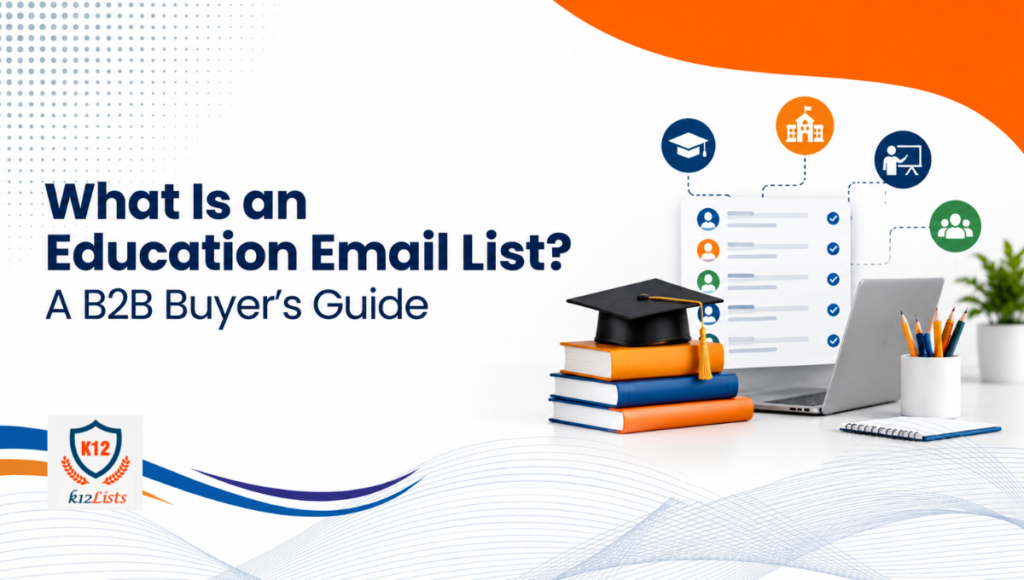
What Is an Elementary School Email List?
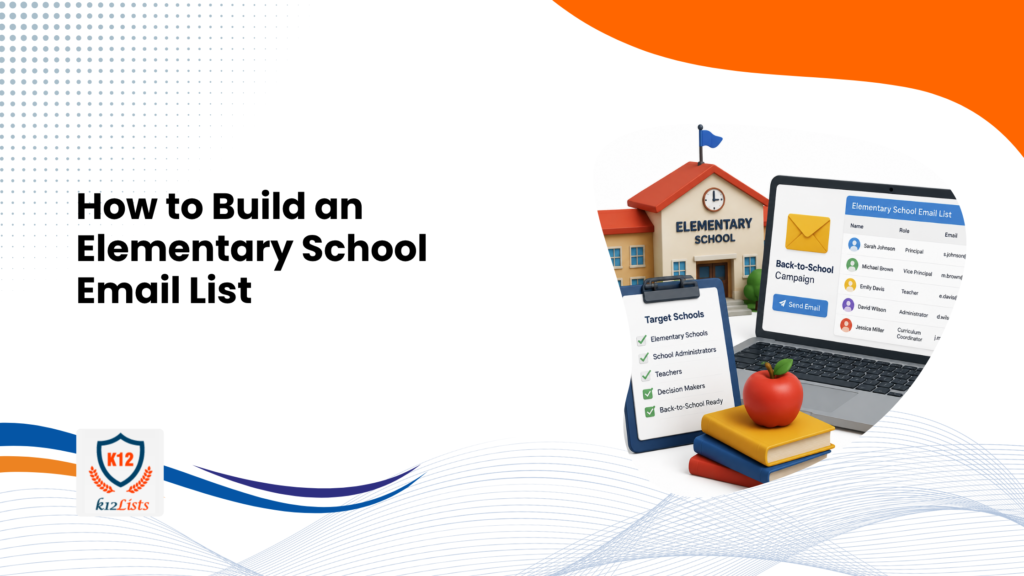
An elementary school email list is a structured and verified database containing contact information of professionals working in elementary education institutions, typically covering grades K–7 or K–6 depending on regional classification.
A high-quality elementary school email list includes:
- School principals and headteachers
- Assistant principals and deputy principals
- School administrators and operations staff
- Curriculum coordinators and instructional leaders
- Academic supervisors and department heads
- District-level education decision-makers
Unlike generic contact databases, an elementary school email list is role-segmented, institution-specific, and decision-maker-oriented, making it significantly more valuable for targeted marketing campaigns.
For example:
- A classroom management platform targets teachers and curriculum leaders
- A school ERP system targets administrative decision-makers
- A student assessment solution targets academic leadership teams
- A communication platform targets principals and school administrators
The effectiveness of any campaign depends on how accurately it reaches the correct decision-maker within the school hierarchy.
Why Back-to-School Campaigns Need Verified School Data
The back-to-school season represents the highest engagement window in the education sector because it aligns with:
- New academic year planning
- Technology adoption decisions
- Budget allocation cycles
- Curriculum updates and approvals
- School infrastructure improvements
During this period, schools are more open to evaluating new vendors and adopting digital solutions.
However, this opportunity is only valuable if marketing campaigns reach verified and relevant contacts.
Without a structured elementary school email list:
- Campaigns fail to reach real decision-makers
- Email bounce rates increase significantly
- Marketing ROI decreases due to irrelevant outreach
- Sales teams waste time on unqualified leads
- Conversion rates remain low despite high campaign activity
Verified education data ensures that outreach is delivered to real stakeholders who can influence purchasing decisions inside schools.
Challenges in Building Elementary School Email Lists Manually
Many organizations still attempt to manually build school contact databases, but this approach introduces significant limitations.
1. Data Inaccuracy
School websites often contain outdated or incomplete contact information, especially during staff transitions or administrative updates.
2. Lack of Role Segmentation
Manual collection does not clearly differentiate between teachers, administrators, principals, and district-level decision-makers.
3. High Time and Resource Cost
Collecting, verifying, and organizing thousands of school contacts manually is inefficient and unsustainable at scale.
4. Compliance Risks
Improper data collection methods may violate email marketing regulations and data usage guidelines.
5. No Geographic or Institutional Structure
Manual datasets lack segmentation by:
- Geography (state, district, country)
- School type (public, private, charter)
- Institution size or enrollment
As a result, manually built lists are often ineffective for large-scale EdTech campaigns.
Better Approach: Using Structured K-12 Data
Modern Education SaaS companies and EdTech marketers rely on structured, verified, and segmented K-12 databases instead of manual data collection.
A platform like K12 Lists provides:
- Verified and updated school contact records
- Role-based segmentation (principals, administrators, curriculum leaders)
- Geographic targeting (US states like Texas, California, New York)
- School type classification (public, private, charter institutions)
- Enriched institutional data for better personalization
This structured approach enables companies to build scalable and predictable outreach systems instead of relying on fragmented lead sources.
You can strengthen your outreach strategy by using structured K-12 datasets that are already segmented and verified. These databases help eliminate manual effort and improve targeting accuracy.
How to Build an Elementary School Email List (Modern Method)
Instead of manual scraping or fragmented sourcing, modern Education SaaS companies use a structured data intelligence approach.
Step 1: Identify School Categories
Segment elementary schools into structured categories such as:
- Public elementary schools
- Private elementary schools
- Charter elementary schools
Each category has different decision-making hierarchies and procurement behavior.
Step 2: Define Geographic Targeting
Geographic segmentation improves outreach relevance and engagement. Focus on high-demand education markets such as:
- United States (state-level targeting like Texas, Florida, California)
- United Kingdom
- UAE and GCC regions
- Other Tier 1 education markets
Step 3: Map Decision-Maker Roles
Effective education outreach requires targeting the correct stakeholders, including:
- Principals (primary decision-makers)
- Assistant principals (operational influencers)
- Curriculum coordinators (academic decision influencers)
- School administrators (procurement and operations)
Understanding hierarchy improves conversion efficiency significantly.
Step 4: Validate and Clean Data
High-quality email lists must include:
- Verified email addresses
- Active institutional contacts
- Reduced bounce rate records
- Updated role and job title accuracy
Data validation directly impacts campaign deliverability and sender reputation.
Step 5: Segment for Campaign Execution
Once structured, data can be segmented into:
- Back-to-school outreach campaigns
- Product launch campaigns
- Demo scheduling campaigns
- Regional or district-level campaigns
Segmentation ensures message relevance and higher engagement rates.
Best Data Fields for High-Converting School Lists
A high-performing elementary school email list should include:
- Full name of contact
- Job title and role classification
- School name and institution type
- Verified email address
- Geographic location (state, district, country)
- Enrollment size (if available)
- Decision-making hierarchy level
- School category (public/private/charter)
These enriched data fields allow Education SaaS companies to run highly personalized and targeted campaigns.
How EdTech Companies Use Elementary School Email Lists
Education SaaS companies and EdTech providers use K-12 data across multiple use cases:
1. Learning Management Systems (LMS)
Used to reach principals and curriculum leaders responsible for digital learning adoption.
2. Assessment and Evaluation Platforms
Target academic leadership teams focused on student performance tracking.
3. School Management Systems
Engage administrators responsible for operational and administrative software adoption.
4. Teacher Training Platforms
Used for professional development and instructional improvement solutions.
5. EdTech Applications
Mobile and web-based learning platforms targeting school-wide adoption.
Why Verified K-12 Data Outperforms Generic Databases
Generic B2B databases often fail in education marketing because they lack:
- Accurate role identification
- School-level segmentation
- Updated verification processes
- Decision-maker mapping
In contrast, verified K-12 data provides:
- Higher email deliverability rates
- Better engagement and response rates
- Improved sales-qualified lead generation
- Stronger ROI on marketing campaigns
For Education SaaS companies, data quality directly determines revenue performance.
Future of Elementary School Marketing
The future of education marketing is rapidly evolving due to:
- AI-driven lead generation systems
- Structured education data intelligence
- Intent-based targeting models
- Personalized outreach automation
- LLM-based search discovery (AEO/GEO)
In this environment, traditional or unstructured email lists are becoming obsolete.
Companies that adopt verified and segmented K-12 data will dominate EdTech sales performance in the coming years.
How K12 Lists Helps Education SaaS Companies
At K12 Lists, we help EdTech companies, publishers, and education service providers:
- Access verified elementary school email databases
- Reach school decision-makers directly and efficiently
- Segment data by geography, role, and institution type
- Improve campaign performance and conversion rates
- Scale back-to-school outreach campaigns globally
Our focus is to provide structured education intelligence that enables predictable growth and higher ROI.
Conclusion
Building an effective elementary school email list is no longer about manual research or fragmented data collection. It is about leveraging structured, verified, and segmented education intelligence that reflects real school decision-making hierarchies.
Back-to-school campaigns succeed when marketers can reach the right decision-makers with precision, relevance, and timing.
With K12 Lists, Education SaaS companies gain access to high-quality, ready-to-use K-12 data that improves outreach performance, increases engagement, and drives scalable growth.
In a competitive EdTech market, success depends on combining strategy with accurate education data intelligence.
Contact us today to build a targeted elementary school email list for your next back-to-school campaign.
Questions We Get Asked Most Often
EdTech companies use elementary school email lists to directly reach school decision-makers, improve campaign targeting, and increase demo bookings and product adoption.
It helps companies target schools during peak buying season, ensuring higher engagement, better response rates, and improved ROI on outreach campaigns.
Key decision-makers include principals, assistant principals, curriculum coordinators, and school administrators responsible for approving education tools and services.
Manual list building is not effective at scale due to outdated data, missing segmentation, and low accuracy compared to verified K-12 databases.
You can request a verified and segmented elementary school email list directly from K12 Lists for targeted education marketing campaigns.
Yes, K12 Lists provides geographic segmentation, allowing you to target specific US states, districts, or regions for focused campaigns.
K12 Lists provides verified, segmented school data that helps EdTech companies improve outreach accuracy, increase conversions, and scale back-to-school campaigns efficiently.Top of Form