
Hey there, fellow marketer!
In today’s data-driven marketing world, connecting with the right audience isn’t just important-it’s everything. When it comes to education marketing, especially in the vibrant K-12 space, blasting generic messages into the void just won’t cut it. Educators and administrators are busy, dedicated professionals juggling a mountain of tasks; their inboxes are no exception.
To truly cut through the noise, your message needs to be relevant, timely, and deeply personalized. That, my friend, is precisely where targeted K-12 schools email lists become your secret weapon. This guide is designed to help you navigate the complexities of data acquisition so you can build lasting relationships with the people who shape the future of education.
Why K-12 Email Lists Are Your Marketing Superpower
Imagine having a direct, compliant, and scalable way to tap into the very hearts and minds of the K-12 community. We’re talking about reaching the primary decision-makers and influencers: the teachers, principals, superintendents, and curriculum directors who are actively shaping the classroom experience.
Whether your passion is educational software (EdTech), innovative classroom supplies, professional development programs, or essential school services, data is the foundation of your strategy. A high-quality K12 Data isn’t just about sending emails; it’s about making a difference and driving your revenue-driving campaigns forward with precision.
The Roadmap to Success
This comprehensive guide is your strategic roadmap. We’re going to walk hand-in-hand through everything you need to know about buying K-12 email lists: from spotting the best providers and understanding tricky compliance requirements to weaving your shiny new list into a campaign that truly makes an impact.
Decoding the K 12 Database – What Are You Actually Buying?
Before you jump into the marketplace, let’s get cozy with what a K-12 Data actually is and why it’s so powerful.
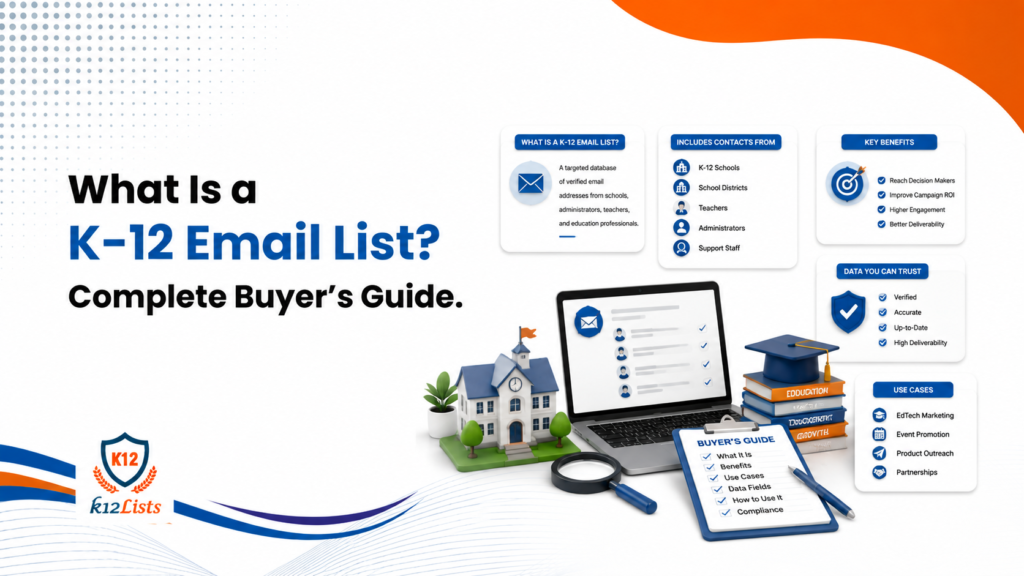
What Exactly Is a K-12 Email List?
Think of K-12 Data as a specially curated treasure chest of contacts, gathered from schools across the country. But it’s not just a list of random names! A premium database is meticulously segmented, breaking down contacts by their specific roles, school types, grade levels, and districts.
Typically, these lists introduce you to key players like:
- Instructional Leaders: Teachers, aides, and department specialists.
- Executive Leadership: Principals, assistant principals, and superintendents.
- Specialized Directors: Curriculum directors, STEM coordinators, and Special Education leads.
- Operations & Infrastructure: IT directors, facilities managers, and purchasing coordinators.
The Goldmine of Information within the Data
A truly quality K-12 email list doesn’t just give you an email address. It provides the “firmographics” and “demographics” necessary for hyper-personalization:
- Full Name & Professional Title: Essential for “Dear [Name]” greetings.
- School Type: Distinguishing between public, private, charter, and magnet schools.
- District Affiliation: Understanding the hierarchy of purchasing power.
- Verified Email Address: The direct line to their inbox.
- Physical Location: State, city, and ZIP code for regional targeting.
- Optional Rich Data: Phone numbers, student enrollment numbers, and funding status (e.g., Title 1).
How the Best Data is Sourced and Verified
This is where trust comes in. Reputable vendors don’t just “scrape” the web or pull names out of a hat. They gather data from trusted, authoritative sources such as:
- Public education directories and state boards of education.
- School and district official websites.
- Professional association registries and conference attendee lists.
- Public records and government filings.
The Validation Process: From Raw Data to “Gold”
Once collected, these contacts aren’t just dumped into a spreadsheet. They undergo a rigorous process:
- Validation: Checking if the email format is correct.
- Duplication: Removing double entries to save you money.
- Segmentation: Tagging contacts by job function and location.
Mastering Your Target – Why “One Size Fits All” Fails in Schools
The K-12 world is incredibly diverse. A message that lights up a District IT Director might fall completely flat with a passionate first-grade teacher. Your solution might be amazing, but if it’s reaching the wrong person, it’s just digital noise.
Critical Segmentation Factors for High Conversion
To avoid being marked as spam, you must tailor your outreach based on:
- Grade Levels: (K-2, 3-5, 6-8, 9-12). High school needs are vastly different from early childhood needs.
- Departmental Needs: A PE teacher has different pain points than an Arts or STEM teacher.
- Purchasing Power: A teacher might be an influencer, but the principal or board member is the buyer.
- Socio-Economic Data: High-income districts versus Title 1 schools require different messaging regarding cost and accessibility.
The Smart Shopper’s Guide – Key Considerations When Buying
Buying a K-12 email list is a significant investment. You want to ensure it adds value, not headaches. Here is your checklist for a smart purchase:
The Blueprint of List Composition
Ask for a full breakdown of the list before you sign. Can the vendor deliver a healthy mix of roles? If you are selling a regional software, can they pinpoint a specific 50-mile radius? Geographic and demographic segmentation are non-negotiable for modern marketers.
Data Accuracy: The 95% Deliverability Rule
This is the most crucial factor. Stale data leads to high bounce rates, which can damage your sender reputation and get your domain blacklisted.
- What is “Verified”? It means the data has undergone email confirmation pings and cross-referencing with official sources.
- Freshness Matters: Always ask for the “date stamp.” If the data hasn’t been refreshed in the last 90 days, it’s already decaying.
Red Flags to Watch For
Run, don’t walk away from vendors who:
- Offer no deliverability guarantee.
- Refuse to provide sample data.
- Sell lists with generic domains (e.g., @gmail.com or @yahoo.com) instead of official school domains (@district.edu).
Comparing Providers – Separating the Wheat from the Chaff
The marketplace is crowded, and every vendor claims to have the “best” data. Put on your detective hat and ask these essential questions:
- “What are your primary data sources?” (Transparency is key).
- “How do you handle opt-outs and ‘Do Not Contact’ lists?”
- “Do you offer a replacement policy for bounced emails?”
Compliance and Legalities – Staying on the Right Side of the Law
When marketing to educators, compliance is not just a suggestion-it’s a legal requirement.
Key Laws You Must Know:
| Law | Jurisdiction | Core Requirement |
| CAN-SPAM | United States | Must include a physical address and a clear “Unsubscribe” link. |
| GDPR | European Union | Requires explicit consent (Opt-in) and strict data handling. |
| CCPA | California | Gives residents the right to know what data is collected and request its deletion. |
Protecting Your Brand Reputation
Non-compliance doesn’t just lead to fines; it leads to reputational harm. Educators are a tight-knit community. If you are viewed as a “spammer,” that reputation will follow you across districts.
Integrating the List into Your Marketing Machine
Congratulations, you’ve got a fantastic new K-12 email list! Now, let’s make it work by integrating it into your existing tech stack.
Weaving Data into Your CRM
Your Customer Relationship Management (CRM) system (HubSpot, Salesforce, Zoho) is your nerve center.
- Import with Tags: Always tag your imported list (e.g., “Purchased_K12_List_Jan2026”) so you can track the ROI specifically from that source.
- Lead Scoring: Assign higher scores to titles like “Superintendent” or “Purchasing Coordinator.”
Choosing the Right Email Marketing Platform (EMP)
Use platforms like Mailchimp or ActiveCampaign to:
- Personalize with Merge Tags: Use the “School Name” in the subject line to increase open rates.
- A/B Test: Test two different subject lines to see which resonates more with teachers versus principals.
When is the Best Time to Reach Educators? Timing Your Outreach for the “Golden Window”
Success in K-12 marketing depends heavily on the “Fiscal Calendar.” If you pitch a high-ticket software in the middle of a “Quiet Phase,” even the most perfect email will likely be ignored because the budget is already locked. To maximize your ROI, you must align your campaigns with the specific budget and academic cycles of your target country.
The following table breaks down the optimal “Golden Windows” for the primary Tier 1 markets:
K-12 Marketing Timing by Region
| Region | Budget Planning Phase | Peak Purchasing Period | The “Quiet” Phase |
| USA | February – April | May – July | August (Back-to-School Rush) |
| UK | January – March | June – July | September (New Term Start) |
| Australia | October – November | January – February | Mid-Dec (Summer Break) |
Best Practices for Engaging Educators
Educators have a unique rhythm to their lives. To succeed, you must respect it.
The Power of Timing
- The School Year Cycle: Avoid sending major pitches during summer breaks (teachers are recharging) or during peak testing weeks (Spring).
- Tuesday/Thursday Rule: Generally, mid-week mornings are the “sweet spot” for professional inbox checking.
Speak Their Language
Show how your solution fits their world. Use terms like:
- Student outcomes
- Classroom management
- Differentiated instruction
- Budget-justified / ESSER funding compliant
Keep it Skimmable
Teachers often check emails during a 5-minute passing period. Use bullet points, short sentences, and a clear Call to Action (CTA) like “Download Your Free Lesson Plan” or “Book a 10-Minute Demo.”
How to Buy K-12 Email Lists – Let Us Help!
Feeling overwhelmed? Don’t be! Sourcing the perfect K-12 list doesn’t have to be a headache. At K12 lists, we specialize in providing the accuracy and granularity you need to succeed.
Your Final Quick Checklist:
- Are the email addresses verified within the last 90 days?
- Does the vendor offer a 95%+ deliverability guarantee?
- Is the data segmented by job title and school type?
- Is the vendor compliant with CAN-SPAM and CCPA?
- Can I see a sample of the data before I buy?
Conclusion: An Investment in Connection
Purchasing a high-quality K-12 schools email list isn’t just an expense; it’s a strategic, ROI-driven investment in your education marketing future. Success isn’t just about buying a list-it’s about being smart: vetting your vendor, ensuring compliance, and integrating that data into value-first campaigns.
When you get it right, K-12 email marketing can:
- Boost brand awareness across thousands of districts.
- Generate qualified leads even during the “off-season.”
- Scale your business faster with lower customer acquisition costs (CAC).
Ready to Turn Data into Dialogue?
Whether you’re launching an innovative new product, expanding your reach nationally, or simply wanting to connect more authentically with educators, the right list makes the difference.
Don’t wait! Contact us today for a free consultation or a custom demo.
Let’s talk about how we can help you make those meaningful connections that drive education forward!
It’s a targeted database of verified educator emails, used to promote products, services, or programs directly to decision-makers in schools.
Always ask your vendor about recent data updates, deliverability guarantees, and compliance with laws like CAN-SPAM or CCPA before you buy.
Peak engagement happens from February to July in the U.S.; avoid summer breaks and testing periods for maximum response.
You’ll get names, job titles, school emails, and often details like school type or district-so you can personalize your outreach.
Break your list down by grade level, job role, or region, so your message always feels relevant to each group.
It’s legal if you comply with regulations like CAN-SPAM and CCPA, ensuring recipients can unsubscribe and their data is handled properly.