
The channels, timing, and targeting framework for EdTech companies, publishers, and education vendors.
Most vendors marketing to schools are doing it wrong. They pull a list of 10,000 school contacts, write one generic email about their product, blast it out in October, and wonder why nobody responds. Then they blame the market: “Schools are hard to sell to.”
Schools are not hard to sell to. They are hard to sell to badly. The K-12 education market represents over $800 billion in annual spending across the United States. Districts purchase technology, curriculum, professional development, furniture, services, and infrastructure every single year. The money is there. The buyers are there. What’s missing, for most vendors, is precision: the right person, the right message, at the right time.
Marketing to K-12 schools is the process of promoting products, services, and solutions to education decision makers, including superintendents, principals, IT directors, curriculum coordinators, and teachers, through targeted channels such as email outreach, direct mail, digital advertising, events, and content marketing. Effective K-12 marketing in 2026 requires verified contact data, role-based segmentation, alignment with school procurement cycles, and multi-channel campaigns personalized to each stakeholder’s priorities and budget authority.
This guide covers the three pillars that separate vendors who close school deals from vendors who chase them: understanding who buys and when, choosing the right channels for each stakeholder, and using verified data to target with precision instead of volume. Whether you sell EdTech, curriculum, school furniture, or SaaS, this playbook applies.
| KEY TAKEAWAY K-12 marketing success in 2026 comes from three things: targeting the right decision makers by role, timing your outreach to the school procurement calendar, and powering every campaign with verified, segmented contact data. Volume without precision is noise. |
| IN THIS PLAYBOOK: 1. Why the K-12 Market Is Different (And Why Most Vendors Get It Wrong) 2. The K-12 Decision-Maker Map: Who You Need to Reach 3. The 7 Most Effective K-12 Marketing Channels in 2026 4. Timing Is Everything: The School Procurement Calendar 5. The Data-Driven Targeting Advantage 6. Your K-12 Marketing Checklist 7. FAQs About Marketing to Schools |
Why the K-12 Market Is Different (And Why Most Vendors Get It Wrong)
The Multi-Stakeholder Problem
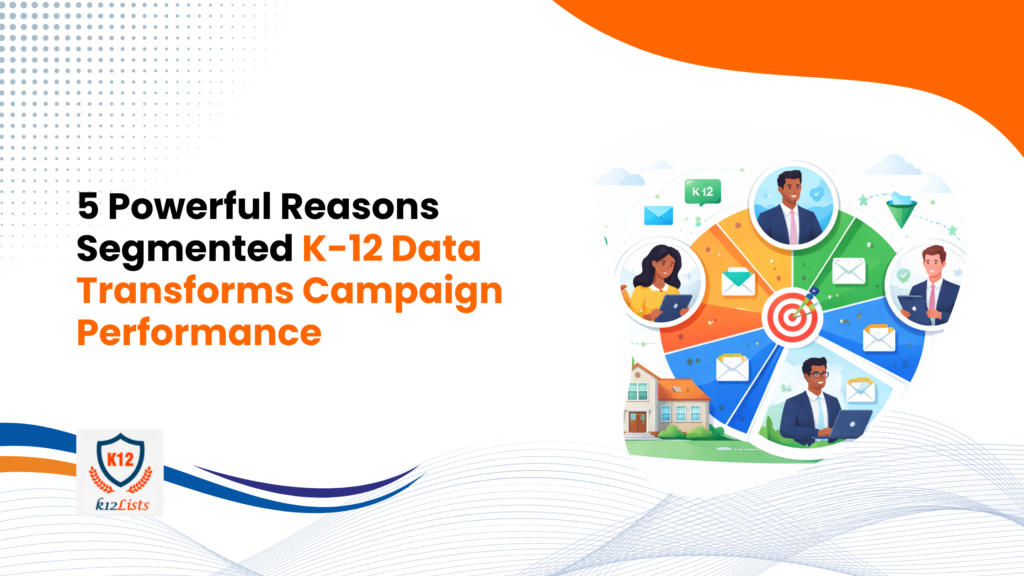
Unlike a typical B2B sale where you pitch one decision maker and close the deal, K-12 purchases involve four to seven stakeholders. A superintendent cares about district-wide ROI and board alignment. A principal wants to know the product won’t create more work for teachers. An IT director needs integration specs and security documentation. A curriculum director needs standards alignment evidence.
Marketing to “the school” doesn’t work because “the school” doesn’t make purchasing decisions. Individual people in specific roles do. And each of those people evaluates your product through a completely different lens. The vendors who win are the ones who send tailored messages to each role, not one pitch to a generic inbox.
The Timing Problem
Schools don’t buy year-round. Budgets are approved on annual cycles. Federal funding releases (Title I, E-Rate) follow federal timelines. Board meetings happen monthly. The window between “we have budget” and “we’ve committed the budget” can be as narrow as 60 days.
Most vendors run campaigns at a constant pace across all twelve months. This means they’re spending the same budget in December, when schools are on winter break and no purchasing happens, as they are in February, when districts are actively evaluating vendors for the coming school year. That’s not a strategy. That’s a calendar-blind reflex.
The 2026 Landscape Shift
Three things have changed the K-12 marketing landscape heading into 2026. First, ESSER funding has fully expired. Schools that spent the past three years flush with federal relief dollars are now back to baseline budgets. Every purchase faces more scrutiny. Second, AI tools are reshaping how schools evaluate and adopt technology, creating new product categories but also new skepticism among administrators who’ve been burned by overpromised tech. Third, data privacy regulations continue to evolve, and schools are more cautious about which vendors they share data with and respond to.
This is not the same market it was in 2023. The vendors who adjust their approach to match the 2026 reality will win. The ones still running 2022 playbooks will keep wondering why schools aren’t returning their calls.
| THE BOTTOM LINE Marketing to K-12 schools requires role-specific messaging, calendar-aligned timing, and verified targeting data. Generic outreach doesn’t work in this market. Precision does. |
The K-12 Decision-Maker Map: Who You Need to Reach
Before you choose a channel or write a single email, you need to know exactly who influences purchasing decisions in schools. The table below maps the six key roles, their authority, what they care about, and the best way to reach them.
| Role | Authority | What They Care About | Best Channel |
| Superintendent | District budget approval | ROI, scalability, board buy-in | Email + direct mail + conferences |
| Principal | School-level adoption | Implementation ease, teacher support | Email + school visits + webinars |
| IT Director | Technology purchasing | Integration, security, compliance | Email + technical demos |
| Curriculum Dir. | Instructional materials | Standards alignment, evidence base | Email + content samples + pilots |
| Teacher | Classroom recommender | Ease of use, time savings, outcomes | Social media + free trials |
| Board Member | Policy & budget oversight | Community impact, cost efficiency | Direct mail + board presentations |
The most effective K-12 marketers don’t target one role and hope for the best. They build multi-touch campaigns that reach three to four roles within the same district simultaneously. A superintendent gets a case study about district-wide ROI. A principal gets an invitation to a 20-minute webinar. An IT director gets a technical spec sheet. Same product. Three messages. Three entry points into the buying committee.
This is why generic contact lists fail. If your data doesn’t tell you who the superintendent is versus who the IT director is at a given district, you can’t segment your messaging. And unsegmented messaging in K-12 is just noise.
Start with a verified school administrator email list that includes role titles, district affiliation, and school type. That’s the foundation everything else is built on.
The 7 Most Effective K-12 Marketing Channels in 2026
Not all channels work equally well in education. Schools operate in a unique environment: limited availability during school hours, committees instead of individual buyers, and a trust threshold that takes longer to clear than most B2B verticals. Here are the seven channels that consistently produce results, ranked by typical ROI for education vendors.
1. Targeted Email Outreach
Email remains the single highest-ROI channel for K-12 marketing, but only when it’s targeted. The difference between a 2% reply rate and a 15% reply rate isn’t your subject line. It’s whether you emailed the right person, at the right school, during the right procurement window.
This means sending a superintendent a message about district-wide student outcomes, not a product feature list. It means emailing IT directors about your SOC 2 compliance and LMS integration, not a generic demo invitation. And it means doing this in February when budgets are being planned, not October when they’ve already been spent.
The foundation of effective email outreach is a verified K-12 email database segmented by role, state, district, and school type. Without that segmentation, email marketing to schools is just spam with better formatting.
2. Direct Mail to Decision Makers
Physical mail still works in education, precisely because most vendors have abandoned it. Superintendents and principals receive hundreds of emails per week but far fewer pieces of direct mail. A well-designed one-page mailer with a QR code linking to a case study can cut through in a way that email number 47 cannot.
The key is targeting: send direct mail to the superintendent and principal at the same district. When two decision makers at the same institution receive your materials independently, it creates internal conversation. That’s not a coincidence. That’s a strategy.
3. Education Conferences and Trade Shows
ISTE, FETC, state-level education conferences, and regional superintendent summits remain critical for relationship building. But the vendors who win at conferences aren’t the ones with the biggest booths. They’re the ones who emailed attendees two weeks before the event with a personalized message: “I noticed you’re attending FETC. We help districts like yours solve [specific problem]. Can we schedule 15 minutes on Tuesday?”
Pre-event outreach using verified attendee data turns a $15,000 booth investment into a pipeline-generating machine instead of a brochure distribution center.
4. Content Marketing and Thought Leadership
Schools trust vendors who demonstrate expertise before asking for a purchase order. The content that resonates in K-12 is practical, not promotional: implementation guides, ROI calculators, research summaries, and case studies from similar districts. A blog post titled “How 3 Rural Districts Improved Math Scores by 22% Using Adaptive Learning” will earn more trust than a product brochure ever could.
Publish content that answers the questions school administrators are already asking. That positions you as a resource, not just another vendor.
5. LinkedIn and Social Selling
Principals and superintendents are increasingly active on LinkedIn. They share articles, comment on education policy, and engage with peers. For vendors, this creates a multi-touch opportunity: connect with a superintendent, share their content, add thoughtful comments, and then follow up via email. By the time you pitch, you’re not a stranger. You’re someone who showed up in their feed three times last month.
6. Free Trials and Pilot Programs
Schools want to test before they buy. A structured pilot program, 30 to 60 days with clear success metrics and principal sign-off upfront, reduces risk for the district and generates the evidence you need to close the full deal. The pilot itself becomes the case study for the next district.
7. Referral and Word-of-Mouth Networks
Schools talk to each other. Superintendents in the same region compare notes. State associations share vendor recommendations. A satisfied school becomes your best sales rep if you build a referral program that makes sharing easy. After a successful implementation, ask your champion: “Which other districts in your region would benefit from this?” Then use that introduction alongside targeted outreach to those specific contacts.
| THE BOTTOM LINE Email outreach, direct mail, and conferences remain the top three channels for K-12 marketing in 2026. But every channel works better when it’s powered by verified, role-specific contact data. The channel matters less than the targeting behind it. |
Timing Is Everything: The School Procurement Calendar
School purchasing follows a predictable annual rhythm. Vendors who align their campaigns with this rhythm convert at dramatically higher rates than those who run campaigns on their own internal schedule. Here’s the calendar.
| Period | What Schools Are Doing | Your Move | Priority Level |
| Jan–Mar | Budget planning, needs assessment, vendor evaluation | Submit proposals, schedule demos, send case studies | HIGHEST |
| Apr–Jun | Board approvals, end-of-year spending, contract renewals | Close deals, push pilot renewals, create urgency | HIGH |
| Jul–Aug | Back-to-school prep, new staff onboarding, PD planning | Run BTS campaigns, target new hires, onboard new buyers | HIGH |
| Sep–Nov | School year in session, implementation, pilot evaluations | Nurture relationships, gather testimonials, plan for Q1 | MEDIUM |
| Dec | Winter break, limited availability | Light touchpoints only, plan January campaigns | LOW |
January through March is your prime selling window. This is when superintendents and principals are actively identifying problems, researching solutions, and requesting proposals. If you’re not in front of them during Q1, you’re already behind the vendors who are.
July through August is the second critical window. Schools onboard new staff, principals finalize back-to-school plans, and districts allocate remaining budget from the previous cycle. This is also when new superintendents and principals start in their roles, which means new decision makers enter the market. Fresh contacts, fresh opportunities.
The Data-Driven Targeting Advantage
Why Generic Data Fails in K-12
The cost of bad data in school marketing is not abstract. You send 10,000 emails. 2,300 bounce because the addresses are outdated. Your sender domain reputation drops. Now even the emails that reach valid inboxes are landing in spam. You’ve spent your budget, burned your deliverability, and have nothing to show for it.
K-12 staff turnover makes this problem worse than in other industries. Principals and superintendents change roles frequently. Teachers move between schools and districts. A contact list that was 90% accurate six months ago might be 75% accurate today. In email marketing, that 15% gap is the difference between a productive campaign and a sender reputation crisis.
What Good K-12 Data Looks Like
A high-quality school contact database includes five things: verified email addresses with 98% or higher deliverability, role-specific segmentation (superintendent versus principal versus IT director), geographic targeting down to the state, district, and zip code level, school type filtering (public, private, charter, parochial), and regular updates at least quarterly to account for staff changes.
This isn’t a premium feature set. This is the baseline for any campaign that expects to generate actual pipeline. If your data provider can’t deliver these five attributes, your campaigns are starting at a disadvantage.
Segmentation That Drives Results
The real power of quality data is precision segmentation. Instead of emailing 50,000 generic school contacts, you target 2,000 IT directors at public high schools in Texas and send them a message about your integration with the LMS their district already uses. That’s not email marketing. That’s a conversation with the right person about the right problem.
Segmentation by role, geography, and school type is what turns a mass email into a relevant message. And relevant messages are the ones that get opened, read, and replied to.
Whether you build your own contact list or work with a verified K-12 data provider, the principle is the same. Precision targeting is the foundation of K-12 marketing success. Everything else, your channels, your messaging, your timing, performs better when it’s built on accurate data.
| THE BOTTOM LINE The difference between a 2% reply rate and a 15% reply rate in school outreach isn’t your subject line. It’s whether you emailed the right person, at the right school, at the right time. That starts with your data. |
Your K-12 Marketing Checklist for 2026
You’ve read the strategy. Here’s the execution framework. Seven steps, in order of priority, that you can start implementing this week.
1. Identify your target roles. Don’t market to “schools.” Map the three to four decision makers who influence your specific product’s purchase. A curriculum tool needs principals and curriculum directors. An IT infrastructure product needs IT directors and superintendents. Know your buying committee before you write a single email.
2. Build or acquire verified contact data. Ensure your list is role-specific, segmented by state and school type, and updated within the last 90 days. If your data provider can’t confirm 98% email deliverability, find one who can.
3. Align campaigns with the procurement calendar. Front-load your outreach budget in January through March and July through August. Reduce spend in December. Plan your content calendar around school budget cycles, not your own fiscal quarter.
4. Craft role-specific messaging. A superintendent cares about district-wide ROI. A teacher cares about ease of use. A principal cares about implementation burden. Write three versions of every campaign, each tailored to a specific role’s priorities.
5. Deploy multi-channel campaigns. Combine email and direct mail for senior decision makers (superintendents and principals). Use LinkedIn and social media for awareness. Offer free trials for teachers. Layer these channels so the same district sees your brand through multiple touchpoints.
6. Track results by role and geography. Monitor open rates, reply rates, and pipeline by role and by state. You’ll quickly discover which segments convert and which need a different message. Double down on what works.
7. Build relationships before the RFP. The vendor who educated the district before the RFP was posted almost always wins the contract. Publish helpful content. Show up at state conferences. Send useful resources with no pitch attached. When the RFP drops, you won’t be a stranger.
Frequently Asked Questions About Marketing to Schools
These are the most common questions we hear from vendors entering or scaling in the K-12 market. Each answer is designed to give you a clear, actionable response.
How do you market to K-12 schools effectively?
Effective K-12 marketing requires targeting specific decision makers, including superintendents, principals, and IT directors, with role-based messaging. Align your outreach with school procurement cycles, focusing on January through March and July through August. Use verified contact data for precision targeting, and combine email, direct mail, and conferences for multi-channel impact.
Who are the key decision makers in K-12 schools?
The primary K-12 decision makers include superintendents (district-level budget authority), principals (school-level adoption), IT directors (technology purchasing), curriculum directors (instructional materials), teachers (classroom influence and recommendation), and school board members (policy and budget oversight). Most purchases require approval from three to five stakeholders.
What is the best time to market to schools?
The best time to market to schools is January through March, when districts plan budgets and evaluate vendors for the next academic year. July through August is the second-best window, as schools prepare for back-to-school operations and onboard new staff. Avoid heavy outreach in December when schools are on winter break.
What marketing channels work best for reaching schools?
The most effective channels for K-12 marketing are targeted email outreach (highest ROI with verified data), direct mail to senior decision makers, education conferences and trade shows, content marketing including case studies and webinars, and LinkedIn for superintendent and principal engagement. Combining channels into multi-touch campaigns produces the strongest results.
How do I get a list of school contacts for marketing?
You can obtain school contact lists from verified B2B education data providers who maintain regularly updated databases of school administrators, teachers, and staff. Look for providers offering role-specific segmentation, state-level geographic targeting, 98% or higher email deliverability, and compliance with CAN-SPAM regulations. Avoid free lists, which typically contain outdated or inaccurate data.
Is it legal to send marketing emails to schools?
Yes, sending marketing emails to school administrators and staff is legal under the CAN-SPAM Act, provided you include a valid physical address, a clear unsubscribe mechanism, accurate sender information, and non-deceptive subject lines. FERPA restricts the use of student data but does not prohibit marketing to school professionals using their professional contact information.
Ready to Reach K-12 Decision Makers With Precision?
You now have the playbook: the roles to target, the channels that work, the timing that matters, and the data foundation that makes it all perform. The gap between vendors who struggle in K-12 and vendors who thrive isn’t product quality. It’s targeting precision.
Every strategy in this guide depends on one thing: reaching the right person, at the right school, at the right time. That requires verified, segmented contact data that you can trust.
| Build Your Custom K-12 Contact List Get a verified school email database segmented by role, state, school type, and district size. 98% deliverability guaranteed. |
Not ready to talk to sales? Explore our K-12 email database to see the roles, states, and school types available, or request a free sample to evaluate data quality firsthand.