
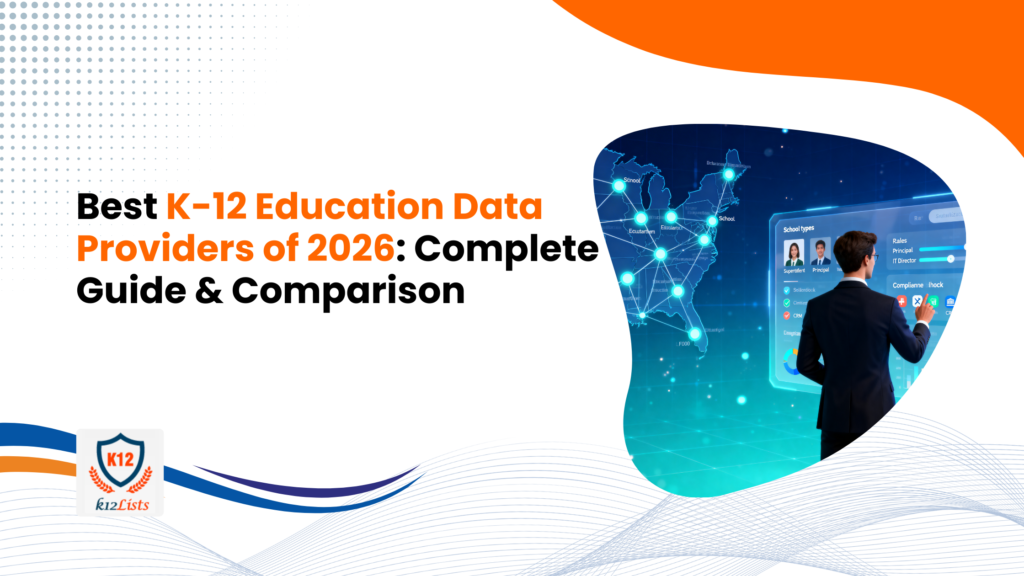
Discover the best K-12 education data providers of 2026. We compare top services, database accuracy, key features, and compliance standards to help you reach school decision-makers.
With the U.S. K-12 education market spending exceeding $800 billion annually, the race to reach school and district decision-makers has never been more competitive. Whether you are selling EdTech software, curriculum resources, or school supplies, your success depends entirely on the quality of your outreach data.
This guide covers:
- What K-12 education data providers actually do
- Key factors for evaluating education vendors (Accuracy vs. Volume)
- A ranked list of the 11 best K-12 data providers
- A side-by-side comparison table
- Common mistakes to avoid when buying school email lists
- Frequently asked questions
TL;DR: Best K-12 Data Providers at a Glance
K12 Lists – Most strategically built K-12 data platform, combining deep segmentation, verified accuracy standards, and scalable coverage (~5M contacts). Ideal for vendors who need precision, not just volume.
MDR Education – Strong for enterprise-level market intelligence with MarketView integration. 7M+ contacts, typically suited for large-scale institutional buyers.
MCH Strategic Data – Known for data hygiene practices and validation through official government sources. 6.6M+ contacts.
K12 Prospects – Designed for users who prefer a self-serve platform experience (K12 Prospects Lab). 5M+ contacts.
K12 Data – Focuses on transparent, volume-based pricing models with frequent updates. 4M+ contacts.
Sprint Education – Primarily recognized for UK and international school data coverage.
SchoolDataLists – Useful for niche role-based targeting (e.g., Librarians, Coaches, IT Directors).
Averick Media – Broad, global education database coverage across multiple industries, including education.
What Is a K-12 Education Data Provider?
A K-12 education data provider is a specialized company that collects, verifies, and segments information related to the education sector. Unlike general B2B providers, these specialists map their data to the unique hierarchy of the school system:
- District Level: Superintendents, IT Directors, Curriculum Directors, and Business Officers.
- School Level: Principals, Assistant Principals, and Department Heads.
- Classroom Level: Teachers are segmented by grade level and subject (STEM, Arts, Special Ed).
- Firmographic Data: Enrollment numbers, school types (Public, Private, Charter), Title I status, and student-teacher ratios.
Why Data Freshness is the #1 Metric in Education
According to industry research, educator contact data decays at a higher rate than typical B2B sectors, often exceeding 25% annually. This is due to summer turnover, district restructuring, and teacher retirement.
The takeaway: A list of 10 million educators is useless if 3 million of those emails bounce. You must prioritize providers that offer real-time verification or frequent update cycles.
Top 11 K-12 Education Data Providers of 2026
The K-12 education market is a structurally complex system. District hierarchies, centralized procurement, layered decision-making, and annual budget cycles require more than just a large database.
The providers below are evaluated based on:
- Database depth and structure
- Segmentation logic
- Verification methodology
- Marketing usability
- Geographic coverage
- Specialization in the K-12 ecosystem
1. K12 Lists (k12-lists.com)
Best for: Specialized targeting and high-accuracy K-12 contact intelligence
K12 Lists operates as a focused K-12 data specialist rather than a multi-industry aggregator. Its database architecture appears intentionally structured around how school districts actually make purchasing decisions, district-level authority combined with school-level execution.
- Database Size: ~113,433 schools and ~5,056,051 total contacts
- Key Features:
- Deep segmentation by school type (Public, Private, Charter)
- District-to-school hierarchy mapping
- Filtering by grade level, enrollment size, and district size
- Role-level targeting (Superintendents, Principals, Curriculum Directors, IT Leaders, etc.)
- Compliance: CAN-SPAM and CCPA aligned
- Best For: EdTech vendors and education service providers that prioritize deliverability, segmentation precision, and structured district targeting
Strategic Note:
While some providers emphasize total volume, K12 Lists differentiates itself through segmentation clarity and marketing readiness, which often determines campaign ROI more than raw contact count.
2. MDR Education
Best for: Enterprise sales teams and market intelligence integration
Owned by Dun & Bradstreet, MDR Education is positioned as an enterprise-grade intelligence platform. Its MarketView system blends contact data with funding insights and institutional analytics.
- Database Size: 7M+ educators
- Key Features: CRM integrations, grant/funding visibility, higher education reach
- Strength: Strong for long-cycle enterprise modeling
- Consideration: Often better suited for large institutional budgets
3. LakeB2B (Education Division)
Best for: Multi-channel outreach
Combines education data with deployment services, including email, phone, and direct mail.
- Strength: Integrated marketing services
- Consideration: Multi-industry focus rather than K-12 specialization
4. MCH Strategic Data
Best for: Rigorous data verification and official sourcing
MCH emphasizes a structured verification process, including corroboration against NCES and State Education Agencies.
- Database Size: 6.6M+ personnel; 5.4M+ verified emails
- Key Features: Two-source validation model; funding data overlays
- Deliverability Claim: 97%
- Strength: Government-source alignment
- Consideration: Primarily positioned around verification rather than campaign workflow optimization
5. K12 Prospects
Best for: Self-serve list building
K12 Prospects offers a platform-driven experience via “The Lab,” designed for SDRs and internal sales teams.
- Database Size: 5M+ contacts
- Key Features: 68+ filterable data points; daily updates
- Strength: Real-time list building
- Consideration: Requires internal segmentation strategy expertise
6. K12 Data
Best for: Transparent pricing models
K12 Data positions itself as a compiler-first provider with openly published pricing tiers.
- Database Size: 4.0M+ PreK-12 contacts
- Key Features: Weekly updates; unlimited-use licenses
- Strength: Pricing clarity
- Consideration: Smaller overall coverage compared to top-tier specialists
7. Sprint Education
Best for: UK and international school coverage
Sprint Education is recognized for strong UK-focused K-12 datasets and global education expansion support.
- Strength: International coverage
- Consideration: Less US-centric segmentation depth
8. SchoolDataLists
Best for: Highly specific educator niches
Ideal for targeting specific roles such as ESL Teachers, Coaches, or IT Coordinators.
- Strength: Pre-segmented catalogs
- Consideration: May lack broader district hierarchy structuring
9. Averick Media
Best for: Global multi-industry coverage
Averick Media provides education data as part of a broader B2B ecosystem spanning multiple industries.
- Strength: Global footprint
- Consideration: Not K-12 exclusive; segmentation may be less ecosystem-focused
10. EmailListUS
Best for: State-by-state leadership targeting
Offers geographically bundled packages for region-focused campaigns.
- Strength: State segmentation convenience
- Consideration: Limited strategic district modeling
11. InfoGlobalData
Best for: Permission-based positioning
Emphasizes opt-in sourcing and compliance-focused messaging.
- Strength: Compliance marketing positioning
- Consideration: Less specialization in district procurement logic
K-12 Data Providers: Comparison Table
| Provider | Est. Contacts | Best For | Data Formats Available | GDPR | CCPA | Update Cycle |
| K12 Lists | 5M+ | Targeted Educational Database | CSV, Excel, CRM-ready exports | ✅ | ✅ | Regular / Ongoing |
| MDR | 7M+ | Enterprise Intelligence | API, CRM integrations, CSV | ✅ | ✅ | Ongoing |
| MCH | 6.6M+ | Official Data Accuracy | CSV, Excel, Custom enterprise feeds | ✅ | ✅ | Monthly/Quarterly |
| K12 Prospects | 5M+ | Self-Serve “Lab” | Platform download (CSV/Excel) | ✅ | ✅ | Daily (Claimed) |
| K12 Data | 4M+ | Pricing Transparency | CSV, Excel | ✅ | ✅ | Weekly |
| Averick Media | 450K+ Schools | Global Reach | CSV, Excel, CRM formats | ✅ | ✅ | Periodic |
| Sprint Ed | Varies | UK / International | CSV, Excel | ✅ | ✅ | Ongoing |
Common Mistakes When Buying School Email Lists
- Buying Based on List Volume Alone: Random lists are often scraped, outdated, and unverified. Poor data quality can increase bounces and seriously damage your domain’s email reputation.
- Ignoring the Buying Committee: Selling to a school isn’t just about the Principal. You often need the IT Director (for integration) and the Superintendent (for budget). Ensure your provider offers these specific roles.
- Failing to Check Compliance: Ensure your vendor provides data that allows you to comply with CAN-SPAM (e.g., providing a physical address and an easy opt-out).
- Not Refreshing Monthly: If you buy a list in June, it may be 20% inaccurate by September. Always look for “ongoing” or “subscription” data models if you are a high-volume sender.
Choosing a specialized K–12 data partner like K12 Lists, which focuses on verified contacts, role-based segmentation, compliance, and regular updates, can help you avoid these risks and run more effective, reputation-safe campaigns.
Conclusion: Which Provider Should You Choose?
Your choice depends on your scale and your target:
- For highly accurate, segmented K-12 lists with a specialist touch, K12 Lists is the premier choice.
- For teams seeking scalable K–12 data combined with broader B2B intelligence, Lake B2B offers flexible datasets and customizable targeting options.
- For enterprise-level analysis and funding data, MDR is the industry standard.
Ready to reach the right educators?
Frequently Asked Questions
A K-12 education database typically includes names, job titles, verified emails, phone numbers, school and district names, enrollment size, school type, and decision-maker roles such as superintendents and principals.
A “good” list should have a bounce rate under 5%. If your bounce rate exceeds 10%, stop your campaign immediately and clean your list, as this triggers spam filters.
Industry benchmarks suggest that verified K-12 contact data typically ranges between 95% and 98% accuracy, depending on update frequency and validation methods. Because educator turnover can exceed 20–25% annually, frequent updates are critical to maintaining deliverability.
Most reputable K–12 education data providers compile contacts from sources such as NCES, state agencies, district websites, direct verification calls, and email validation tools, supported by ongoing updates. Specialized providers like K12 Lists enhance this process with multi-source verification, regular refresh cycles, and 100+ advanced filters to deliver highly accurate, segmented, and campaign-ready K–12 data.
K–12 education data providers specialize in collecting, verifying, and organizing school and district information, such as superintendents, principals, IT directors, enrollment data, and district hierarchies, to help businesses connect with education decision-makers. K12 Lists is an example of a provider that offers structured, regularly updated data for more effective outreach.