
Why Selling to Schools Requires a Different Approach
Selling to schools looks simple on paper. A company develops an education product, identifies schools as potential customers, reaches out to administrators, and expects conversations to begin.
However, businesses running K-12 marketing campaigns quickly discover that education sales work differently from many other industries.
Schools do not make purchasing decisions based only on product features or pricing. The process involves multiple stakeholders, strict budget planning, approval procedures, and long evaluation periods. A solution that works well for one school may not fit another because every institution has different goals, challenges, and resources.
This is why many companies struggle with selling to schools even when they have valuable products or services.
The challenge is not always the quality of the offering. Often, the problem comes from reaching the wrong audience, using broad targeting, or failing to understand how school purchasing decisions happen.
This guide explains why education sales are complex, who influences buying decisions, common challenges businesses face, and how a targeted approach can improve K-12 outreach results.
Why Does Selling to Schools Require a Different Approach?
In short: Selling to schools is more complex than traditional B2B sales because education purchasing involves multiple decision-makers, longer approval cycles, budget limitations, and specific institutional priorities. Companies need a focused K 12 marketing strategy that reaches the right people with relevant messaging.
The education industry operates differently from industries where a single executive can approve a purchase quickly.
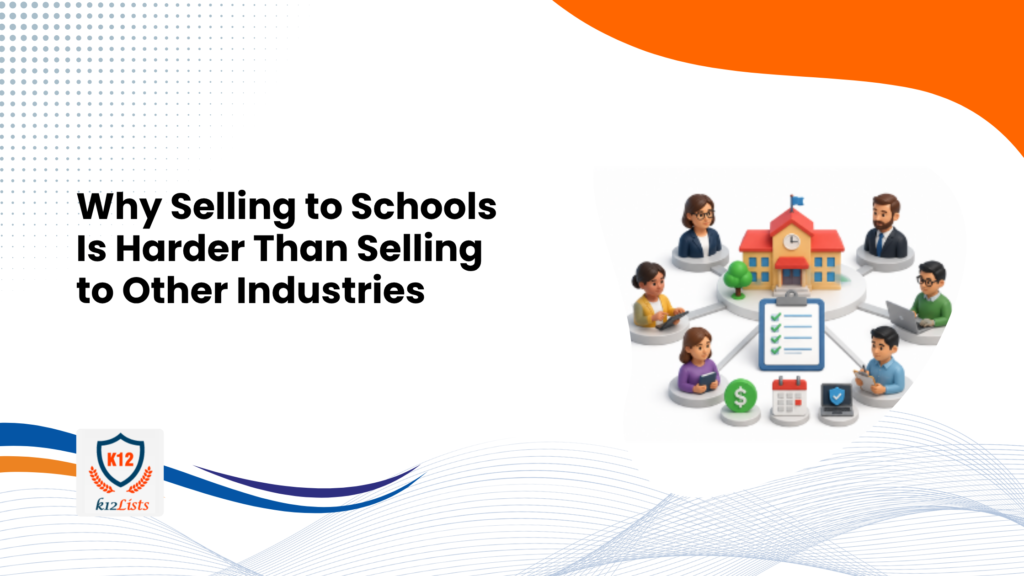
A company selling software to businesses may target a department head or executive responsible for purchasing decisions. In schools, buying decisions often involve administrators, educators, technology teams, finance departments, and district-level leaders.
Each stakeholder evaluates solutions from a different perspective.
For example:
- Teachers may focus on classroom usability.
- Technology teams may evaluate system compatibility.
- Administrators may consider long-term value.
- Finance teams may review budget impact.
- District leaders may assess organization-wide benefits.
A successful education sales strategy requires understanding these different priorities and building communication around them.
Who Makes Purchasing Decisions in Schools?
Schools have multiple layers of decision-makers. Identifying the right contact depends on the type of product, the institution size, and the purchasing process involved.
Many businesses fail in education outreach because they target schools broadly without understanding who actually influences decisions.
Principals and School Administrators
Principals often influence school-level purchasing decisions.
They evaluate solutions based on factors such as:
- Student outcomes
- Teacher support
- Operational improvements
- Budget availability
For products like classroom tools, educational resources, or student programs, principals can be important contacts because they understand daily school challenges.
However, reaching principals requires relevant messaging. A generic sales message is unlikely to create interest because administrators receive many vendor communications.
Companies need to explain how their solution addresses real school priorities.
District Leaders and Superintendents
District-level leaders often influence larger purchasing decisions.
They may evaluate solutions that impact multiple schools, including:
- Learning platforms
- Administrative technology
- Training programs
- District-wide resources
District decision-making usually involves more evaluation because the investment affects multiple locations.
Businesses targeting districts need to demonstrate:
- Scalability
- Long-term value
- Implementation support
- Measurable outcomes
Teachers and Educators
Teachers may not always approve purchases, but they play an important role in adoption.
Many education solutions succeed because educators find them useful in the classroom.
Teachers influence decisions related to:
- Learning resources
- Classroom technology
- Teaching tools
- Professional development programs
Understanding teacher needs helps businesses create stronger messaging.
IT Directors and Technology Teams
Technology teams have become increasingly important in education purchasing.
For EdTech companies, IT professionals often evaluate:
- Security requirements
- Integration capabilities
- Technical support
- System compatibility
A product that solves an educational challenge but creates technical problems may face adoption barriers.
Purchasing Managers
Purchasing teams manage procurement processes and vendor requirements.
They may evaluate:
- Pricing
- Vendor documentation
- Contracts
- Purchasing procedures
Understanding procurement requirements helps businesses avoid delays during the sales process.
What Are the Biggest Challenges in Education Sales?
Education sales challenges usually come from complex decision-making, longer timelines, and difficulty reaching the right school contacts. Businesses need a targeted approach instead of traditional mass outreach methods.
Long Sales Cycles
One of the biggest differences between education sales and other industries is the purchasing timeline.
Schools often work around:
- Academic calendars
- Funding schedules
- Approval meetings
- Procurement processes
A decision that appears simple may require several discussions before approval.
For example, a school evaluating a new digital learning platform may need input from:
- Teachers
- Administrators
- Technology teams
- Finance departments
Companies that understand these timelines can create better follow-up strategies and avoid expecting immediate results.
Multiple Stakeholders Influence Decisions
Unlike some industries where one person controls purchasing, schools often involve committees and multiple influencers.
A successful K-12 lead generation strategy must consider the entire decision-making structure.
Reaching only one contact may not be enough.
Businesses should identify:
- Users of the solution
- Budget owners
- Decision influencers
- Approval authorities
This creates a stronger understanding of the buying process.
Budget Constraints
Schools operate under strict financial limitations.
Even when a solution provides significant value, budget availability can determine whether a purchase moves forward.
Marketing messages should focus on practical benefits, including:
- Improving efficiency
- Supporting educators
- Reducing workload
- Enhancing learning experiences
Businesses should communicate value rather than only product features.
Building Trust Takes Time
Schools are careful when selecting vendors because their decisions affect teachers and students.
Trust is a major factor in education purchasing.
Businesses can build credibility by demonstrating:
- Industry knowledge
- Previous experience
- Understanding of school challenges
- Reliable support
Strong relationships often lead to better long-term opportunities.
Why Do Traditional B2B Sales Strategies Fail in K-12 Marketing?
Traditional B2B strategies often fail in education because schools require specialized targeting, relevant messaging, and accurate contact information. A broad approach usually creates low engagement and wasted outreach efforts.
Many businesses apply corporate sales tactics directly to education markets.
This creates several problems.
Generic Messaging Does Not Connect With Schools
Schools are not simply another business segment.
Their priorities are different.
A message focused only on revenue growth may not connect with educators.
Education audiences respond better to messages about:
- Student support
- Teacher productivity
- Learning improvement
- Administrative efficiency
Broad Databases Create Poor Targeting
A large contact list does not automatically create better results.
If businesses cannot identify:
- The right school type
- Relevant decision-makers
- Appropriate locations
- Specific education needs
campaign performance suffers.
Quality targeting is more valuable than contact volume.
Outdated Data Reduces Campaign Performance
Education professionals frequently change roles.
Administrators move between schools. Teachers change institutions. Departments reorganize.
Using outdated information can lead to:
- High email bounce rates
- Low deliverability
- Incorrect targeting
- Lost opportunities
Accurate contact information is essential for effective education outreach.
How Can Companies Improve Their K-12 Sales Strategy?
Successful education marketers focus on precision rather than volume. They define their audience, segment contacts, personalize communication, and use reliable education data to improve outreach performance.
Define Your Ideal School Audience
Before launching campaigns, companies should clearly identify their target audience.
Consider:
- School type
- Geographic region
- Institution size
- Decision-maker roles
- Educational challenges
For example, an EdTech company selling classroom software may target technology directors and administrators rather than every educator.
Segment School Contacts
Segmentation improves campaign relevance.
Businesses can organize contacts based on:
- Job roles
- School categories
- Locations
- District sizes
- Education requirements
A personalized approach increases the chance of meaningful engagement.
Personalize Education Outreach
School professionals receive many marketing messages.
Generic outreach often gets ignored.
Effective communication should explain:
- Why the solution matters
- How it solves school challenges
- Who benefits from it
Personalized messaging shows that a company understands the education environment.
Use Verified Education Data
Reliable education data supports better decision-making.
A verified education email database helps businesses identify relevant contacts and create more focused campaigns.
Useful data attributes may include:
- Contact names
- Job titles
- School information
- Location details
- Institution type
Accurate data helps businesses improve outreach efficiency and reduce wasted resources.
How Verified K-12 Data Supports Better School Outreach
Verified K 12 data helps businesses connect with relevant education professionals by improving targeting accuracy, reducing outdated contacts, and supporting personalized marketing campaigns.
Education markets change frequently, making data quality an important factor in outreach success.
A reliable education database allows businesses to:
- Reach active school professionals
- Identify relevant decision-makers
- Improve campaign segmentation
- Support targeted communication
For companies selling educational products, technology, training, or resources, accurate contact information creates a stronger foundation for relationship-building.
The goal is not simply reaching more schools.
The goal is reaching the right schools and the right people within those institutions.
Practical Checklist for Selling Successfully to Schools
Use this checklist to improve your education outreach strategy:
- Define your ideal school audience before launching campaigns
- Identify decision-makers involved in purchasing decisions
- Segment contacts based on role, location, and institution type
- Use accurate and updated education contact data
- Create messaging focused on school challenges
- Align marketing campaigns with education timelines
- Track engagement and conversion quality
- Maintain updated contact databases regularly
A structured approach helps businesses create more effective education marketing campaigns.
Conclusion
Selling to schools requires a different strategy because education purchasing decisions involve multiple stakeholders, longer timelines, and unique institutional priorities.
Many companies struggle with education sales not because their products lack value, but because they approach schools without understanding how decisions are made.
Successful K 12 marketing depends on:
- Reaching the right decision-makers
- Creating relevant communication
- Understanding education challenges
- Using accurate contact information
- Building long-term relationships
Businesses that focus on targeted outreach are better positioned to create meaningful connections with schools and education professionals.
Build Stronger Education Outreach With Verified K-12 Data
Reaching the right education professionals is the foundation of successful school marketing.
K12-Lists provides verified and segmented K-12 education databases designed to help businesses connect with principals, administrators, educators, and education decision-makers.
Whether you are an EdTech provider, publisher, nonprofit organization, or education supplier, targeted education data can help improve outreach accuracy and campaign performance.
Contact K12-Lists to explore customized education data solutions for your marketing goals.
People also Ask Questions About Selling to Schools
Why is selling to schools difficult?
Selling to schools is challenging because education purchasing involves multiple decision-makers, structured approval processes, budget limitations, and longer sales cycles. Companies need targeted outreach strategies that address the priorities of administrators, educators, and district leaders.
How long does the education sales process usually take?
The education sales process can vary depending on the solution and institution size. Many education purchases may take several months because schools often require evaluations, approvals, budgeting discussions, and procurement procedures before making decisions.
What is a K-12 education database?
A K-12 education database is a collection of verified contact information for professionals working in schools and educational institutions. It may include principals, administrators, educators, technology leaders, and other school decision-makers.
Why is verified school contact data important?
Verified school contact data helps businesses improve outreach accuracy by reducing outdated information, improving deliverability, and helping marketers reach relevant education professionals.
How can EdTech companies reach school administrators?
EdTech companies can reach school administrators by identifying the right decision-makers, creating relevant messaging, and using targeted education data that supports personalized outreach campaigns.
Can K-12 email lists improve education outreach?
Yes. A segmented K-12 email list can help businesses connect with relevant education professionals based on factors such as location, role, and institution type, improving campaign targeting and efficiency.