
Marketing to schools is different. Anyone who has worked in B2B education marketing knows this firsthand.
The K‑12 space isn’t just another industry vertical – it’s layered, committee-driven, budget-sensitive, and deeply role-specific. A classroom teacher, a school principal, and a district superintendent might all sit in the same building, but they approach decisions from completely different perspectives.
And yet, many companies still send the exact same email to all of them.
That’s usually where campaign performance starts to decline.
Low engagement.
Minimal conversions.
Unqualified leads.
Frustrated sales teams.
This is exactly where Segmented K‑12 Data changes the outcome.
When you stop treating the education market like one giant audience and start using K‑12 Email List Segmentation, your messaging becomes relevant. And relevance is what drives performance.
In this article, we’ll explore how K‑12 Data for Marketing becomes significantly more powerful when it’s segmented, and why K‑12 Data Segmentation Strategies directly impact engagement, conversions, and ROI.
Curious how a segmented K-12 Schools Email List can transform your marketing efforts? Keep reading to discover the key benefits and real-world applications.
Understanding Segmented K‑12 Data
What Is Segmented K‑12 Data?
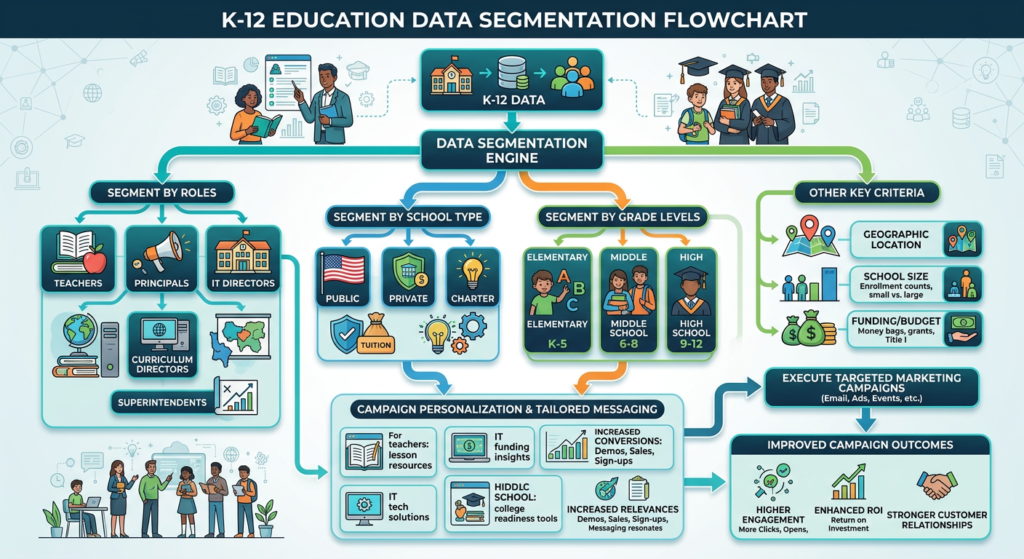
At its core, Segmented K‑12 Data is simply organized K‑12 Education Data broken into meaningful groups for targeted outreach.
Instead of maintaining one large K‑12 Database for Campaigns, segmentation allows you to filter contacts based on:
- Role (teachers, principals, IT directors, superintendents)
- School type (public, private, charter)
- Grade level (elementary, middle, high school)
- District size
- Geographic region
- Budget classification
- Technology adoption
- Subject specialization
This type of Audience Segmentation transforms generic K‑12 Schools Data into strategic assets for Data-driven marketing for K‑12.
For example:
- A cybersecurity provider should focus on district IT directors.
- A literacy curriculum company should target elementary principals and reading specialists.
- A district-wide LMS provider should prioritize superintendents and procurement officers.
Without segmentation, your message is broad.
With segmentation, your message is specific.
And specific messaging wins in the K‑12 sector.
Why K‑12 Email List Segmentation Matters So Much
The K‑12 purchasing process is rarely simple.
There are approval layers.
Budget cycles.
Committees.
Board oversight.
When you send unsegmented campaigns using generic K‑12 marketing data, a few predictable things happen:
- Open rates remain low.
- Click-through rates suffer
- Unsubscribes increase
- Lead quality declines
The issue isn’t always your solution.
It’s misalignment.
Effective Education Email List Segmentation ensures that your messaging matches real-world responsibilities. That alignment is what drives stronger Email campaign optimization.
How Segmented K‑12 Data Improves Campaign Performance
1. It Enables Real Personalization
Most marketers think personalization means adding a first name to an email.
That’s surface-level.
True personalization, the kind that powers Personalized K‑12 Marketing Campaigns — speaks directly to a recipient’s responsibilities.
A teacher is thinking about:
- Lesson plans
- Student engagement
- Time management
A principal is thinking about:
- School performance metrics
- Staff retention
- Parent communication
A superintendent is thinking about:
- District-wide ROI
- Budget allocation
- Board reporting
When you use Targeted K‑12 Email Lists, your messaging naturally adapts to these concerns.
That emotional shift from “this is marketing” to “this is relevant to me” — dramatically improves engagement.
2. Higher Open Rates Through Precision
Subject lines become sharper when using Segmented Education Data.
Compare:
- “Improve Student Outcomes This Year”
- “How District IT Leaders Are Cutting Support Tickets by 35%.”
The second one reflects real K‑12 sector targeting. It speaks directly to a role and a challenge.
Campaigns built on Targeted email lists consistently show:
- 20–30% higher open rates
- Significantly stronger click-through rates
- Improved demo conversions
This is the difference between broad outreach and Effective K‑12 Email Campaigns.
3. Stronger Lead Quality and Faster Sales Cycles
Segmentation doesn’t just improve engagement — it improves who engages.
When you focus on:
- Superintendents
- Curriculum directors
- Technology leaders
- Procurement officers
You align your outreach with actual purchasing authority.
That alignment strengthens K‑12 Education Lead Generation and reduces wasted follow-up time.
Better targeting leads to better conversations.
Better conversations lead to faster deals.
4. Smarter Budget Allocation
Every marketing effort carries a cost.
Using broad K‑12 Schools Data for Lead Generation spreads resources thin. But focused segmentation allows you to prioritize high-value groups, such as:
- Large-enrollment districts
- Schools in states with new funding initiatives
- Recently promoted administrators
- Districts adopting new technology
This approach enhances K‑12 Marketing Campaigns by improving cost-per-acquisition and maximizing ROI.
Strategic segmentation transforms your database into Segmented databases for marketing performance.
5. Measurable ROI Through K‑12 Data Analytics
The real power of K‑12 Data Analytics appears when segmentation meets measurement.
When you track:
- Open rates by job title
- Conversion rates by district size
- Engagement by geography
You uncover patterns that refine future campaigns.
This level of insight turns K‑12 Data for Marketing into a long-term competitive advantage.
Segmentation isn’t just a tactic.
It’s a measurable revenue strategy.
Interested in exploring how segmented K-12 data can improve your campaigns? Contact us for a personalized consultation and see the impact for yourself.
Key Benefits of Using Segmented K‑12 Data
Precise Decision-Maker Targeting
Education purchases involve:
- Budget holders
- Influencers
- Technical evaluators
- End users
Segmented K‑12 Data ensures each stakeholder receives relevant messaging — a core principle of strong Education Marketing Strategies.
Flexibility in Scaling Campaigns
The education market shifts constantly.
New principals are appointed.
Districts receive grants.
Technology initiatives roll out.
With structured K‑12 Education Data, you can quickly adjust segments without rebuilding your entire list.
This agility strengthens long-term K‑12 Targeted Outreach.
Better Deliverability and List Hygiene
Organized Segmented K‑12 Data improves:
- Bounce rates
- Sender reputation
- Inbox placement
- Engagement metrics
Clean data improves trust with email platforms – a key factor in sustainable Email Marketing for K‑12 Schools.
Best Practices for K‑12 Data Segmentation Strategies
1. Define Your Ideal Education Buyer
Ask:
- Who signs the contract?
- Who influences the purchase?
- Who benefits from the solution?
Build your segments around those answers.
2. Customize Messaging by Role
Follow Email List Segmentation Best Practices:
- Adjust tone by authority level.
- Use role-specific examples
- Highlight relevant metrics
- Address unique pain points.
Segmentation without tailored messaging doesn’t unlock full performance.
3. Continuously Optimize Using Data
Monitor:
- Engagement by segment
- Conversion by district size
- Response trends over time
Refinement through K‑12 Data Analytics keeps campaigns adaptive and performance-driven.
A Real-World Example
An EdTech company offering a digital math curriculum relied on a broad K‑12 Database for Campaigns. Their engagement rates were stagnant.
After reviewing their sales data, they discovered most deals were approved by curriculum directors and principals.
They implemented K‑12 Email List Segmentation into three groups:
- Elementary principals
- District curriculum directors
- Math department heads
Each segment received role-specific messaging.
Within one quarter:
- Open rates increased significantly.
- Click-through rates doubled
- Demo requests improved
- Lead quality strengthened
The product didn’t change.
The Segmented K‑12 Data approach did.
Conclusion
In today’s competitive education landscape, generic outreach no longer works.
Using Segmented K‑12 Data transforms raw K‑12 Schools Data into strategic marketing intelligence.
When you implement structured Education Email List Segmentation, your campaigns become:
- More relevant
- More efficient
- More cost-effective
- More profitable
The right message, delivered to the right stakeholder, using structured K‑12 Data for Marketing, creates stronger engagement and measurable ROI.
If your campaigns feel underwhelming, the issue may not be your solution.
It may be your segmentation.
Ready to boost your K-12 campaigns with targeted data?
Contact us today for a free consultation and learn how we can help you reach the right audience.
Answers to Key Questions About K-12 Data and Marketing Strategies
Segmented K‑12 Data is organized K‑12 Education Data categorized by role, geography, school type, or other attributes to enable targeted outreach and improved campaign performance.
It increases relevance, improves open and click-through rates, enhances lead quality, and supports better Email campaign optimization.
Common stakeholders include superintendents, principals, curriculum directors, IT leaders, and procurement officers – depending on your solution.
Yes. In modern Data-driven marketing for K‑12, segmentation is foundational to achieving strong ROI and sustainable campaign growth.